Reconstruction
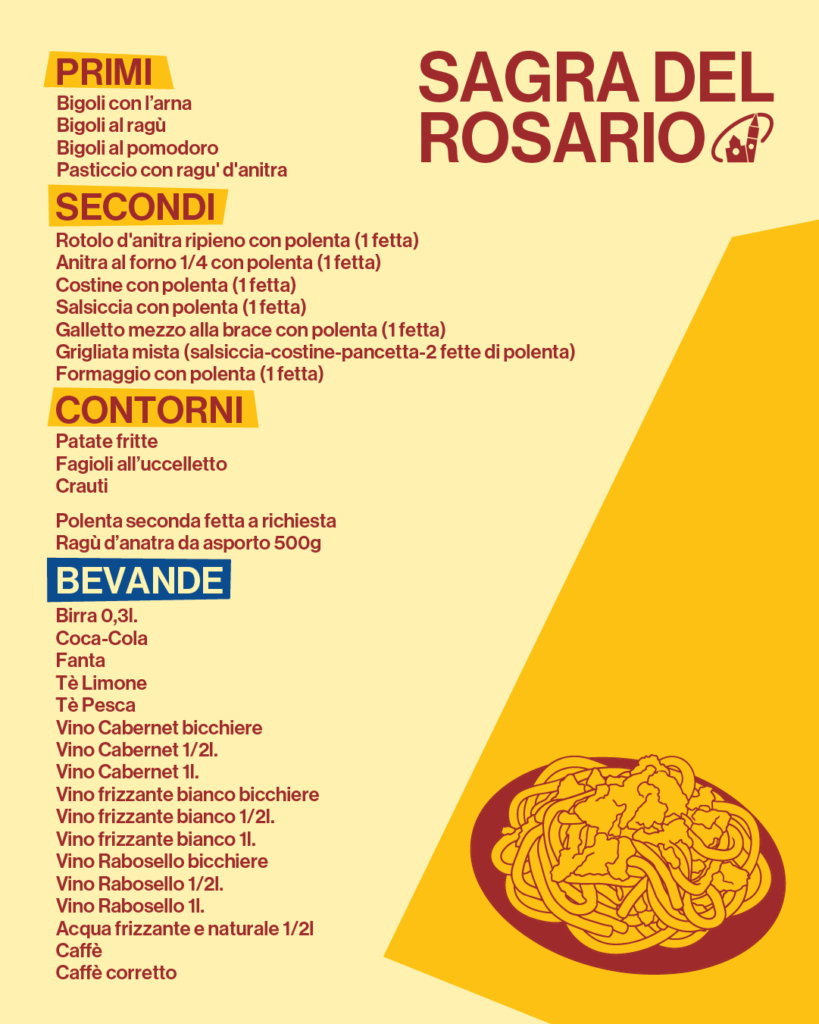
At Torri di Quartesolo, east of Vicenza, arna al forno means more than roast duck. In the local dialect, arna denotes duck, and the bird gives its popular name to the parish Sagra del Rosario: the Festa dell’Arna. The official 2026 menu presents a quarter of oven-roasted duck with polenta, while bigoli with duck, duck ragù, duck-filled pasta bake and a stuffed duck roll extend the ingredient across the meal. The result is a religious village festival whose public identity is expressed through a particular food.
The celebration has documentary roots in 1763. A record cited from the book of officers of Torri’s Rosary confraternity refers to a Rosary “solemnity” on March 18 and records an October expenditure of 27 troni for celebratory gunfire. This establishes the festival’s eighteenth-century existence, but it does not document what people ate. No surviving 1763 menu cited by the organizers names roast duck, so the age of the religious observance should not automatically be treated as the proven age of its signature dish.
Roasting nevertheless suits domestic duck particularly well. Heat cooks the meat while rendering some of the substantial fat beneath the skin. Modern Torri service pairs the bird with a slice of polenta, a staple deeply embedded in Veneto food history. By the eighteenth century, maize occupied an important place in the region’s fields and rural diet. Rich poultry and its cooking juices could turn otherwise plain polenta into feast food, although the precise historical form of Torri’s pairing remains insufficiently documented.
Duck is also used economically in Vicentine bigoli traditions. The festival’s published recipe calls for a young duck to be simmered with onion, carrot, celery, garlic, cloves and herbs. The broth cooks the thick, rough pasta; meat and giblets are chopped and browned with butter and sage for the dressing. Other documented versions debate whether the sauce should contain principally offal or the bird’s flesh as well. These variations show how one animal could provide broth, sauce and a separate meat course rather than a single standardized recipe.
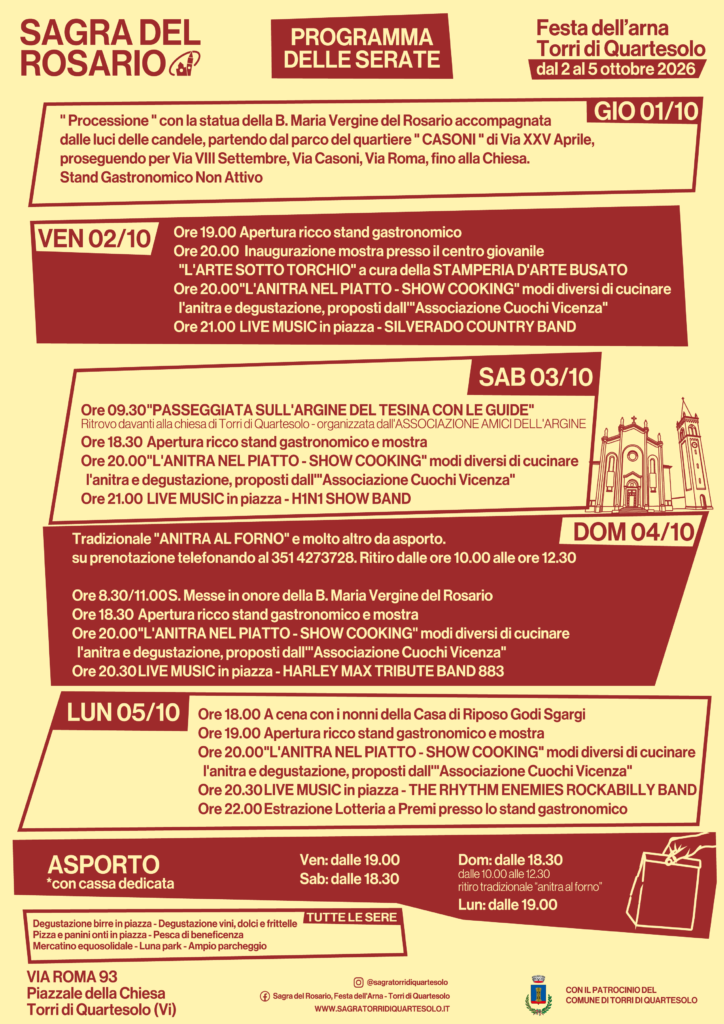
Today the festival moves this household logic into a communal stand staffed for large-scale service. The 2026 program combines Masses and a candlelit procession with food service, takeaway roast duck, exhibitions, music and cooking demonstrations. Its significance therefore lies less in an unbroken, provable eighteenth-century duck recipe than in the modern preservation of a regional poultry repertoire. Roast arna, polenta and duck-dressed bigoli allow Torri to translate parish devotion, autumn gathering and volunteer labor into an edible statement of local identity.
Nutrition
| Nutrient | Amount | Basis |
|---|---|---|
| Energy | 337 kcal | calculated |
| Protein | 19 g | calculated |
| Fat | 28.4 g | calculated |
| Carbohydrate | 0 g | referenced |
| Fibre | 0 g | referenced |
| Glycaemic index | Not established | insufficient evidence |
| Glycaemic load | 0 | calculated |
| Micronutrients | ||
| iron | 2.7 mg | calculated |
| phosphorus | 156 mg | calculated |
| zinc | 1.9 mg | calculated |
| selenium | 20 mcg | calculated |
| niacin | 4.9 mg | calculated |
Typical serving: approximately 150 g edible roasted duck from a festival portion; excludes bones, polenta, gravy and other accompaniments
Values use USDA composition for domestic duck, meat and skin, cooked and roasted. Actual festival portions vary with the cut, proportion of skin, degree of fat rendering and whether rendered fat or cooking juices are served. Polenta is excluded.
Historical context
At this time, in 1763, Torri di Quartesolo lay within the mainland territories of the Republic of Venice, on the route linking nearby Vicenza with Padua. The surrounding eighteenth-century Veneto landscape combined wheat and maize fields with vines, mulberries and mixed agricultural holdings. Maize had become a major crop and polenta a central rural food, while confraternities organized worship and public festivities at parish level. The documented expenditure on celebratory gunfire places Torri’s Rosary solemnity within this world of local religious associations, agricultural communities and highly visible communal observance.
Evidence
Written sources
ModerateThe festival organization cites a 1763 Rosary confraternity account recording the solemnity and expenditure for celebratory gunfire. The underlying archival document was not independently inspected here, and the cited entry does not identify duck or a festival menu.
Recipe evidence
StrongThe festival website publishes a detailed recipe for bigoli with duck, including the bird, giblets, broth, aromatics, butter, sage and grated cheese. Its 2026 menu directly lists oven-roasted duck with polenta.
Food identification
StrongThe official menu identifies the principal dish as anitra al forno, while the festival consistently uses arna as the local name for duck.
Dating
ModerateThe year 1763 is supported for the Rosary celebration, not for the first preparation of roast duck at the event. The date when arna became the festival's defining food remains undocumented in the sources reviewed.
Preparation method
ModerateOven roasting and service with polenta are directly documented in the current menu. Detailed historical roasting temperatures, seasonings, equipment and portioning are not established.
Geographic attribution
StrongOfficial parish and municipal sources place the festival in the church square at Torri di Quartesolo, Vicenza.
Historical interpretation
LimitedThe association of autumn duck husbandry, harvest gatherings and the eighteenth-century festival is a reasonable regional reconstruction, but direct evidence for Torri's household duck cycle in 1763 was not found.
Sources
- 1.Sagra del Rosario di Torri di Quartesolo (2026). La sagra. Official Sagra del Rosario website. www.sagratorridiquartesolo.it/sagra-del-rosario-Modern synthesis
- 2.Sagra del Rosario di Torri di Quartesolo (2026). Programma della Sagra del Rosario 2026. Official festival program. www.sagratorridiquartesolo.it/wp-content/uploadsHistorical primary source
- 3.Sagra del Rosario di Torri di Quartesolo (2026). Menu della Sagra del Rosario 2026. Official festival menu. www.sagratorridiquartesolo.it/wp-content/uploadsHistorical primary source
- 4.Renzo Rizzi (2020). Bigoli e gargati. Civiltà della Tavola, Accademia Italiana della Cucina, no. 322. accademiaitalianadellacucina.it/sites/default/fiModern synthesis
- 5.Comune di Torri di Quartesolo (2023). Storia del Comune. Comune di Torri di Quartesolo. www.comune.torridiquartesolo.vi.it/vivere-il-comModern synthesis
- 6.U.S. Department of Agriculture, Agricultural Research Service (2018). Duck, domesticated, meat and skin, cooked, roasted, FDC ID 172409. FoodData Central, SR Legacy. fdc.nal.usda.gov/fdc-app.html#/food-details/1724Scientific literature
Limitations
- moderatedescription
The claim that the 2026 festival had already concluded on October 5 is premature as of Monday, October 5, 2026. The official program schedules activities that evening through at least the 10:00 p.m. lottery drawing.
- moderatedate end
A date_end of 2026 may misleadingly imply that the recurring festival or dish ends in 2026. Available evidence presents it as an ongoing annual tradition; 2026 is only the documented current edition.
- minordescription
The 1763 evidence documents the Rosary solemnity and celebratory gunfire, not roast duck. The date when arna al forno became the festival's signature preparation remains unestablished.