
Environments and Adaptation
The oldest food evidence belongs to particular landscapes, not to one Paleolithic menu. A Caucasian forest-steppe, an East African rift basin, an island, a rainforest and the Arctic each posed a different problem, and each preserves a different, partial record of how people met it.
A landscape is not a menu
The phrase “Paleolithic diet” implies one menu, eaten by one kind of person, over one stretch of time. The archaeological record supports none of the three. The Paleolithic begins with the earliest known stone tools, about 3.3 million years ago [1], and ends with the last glacial period. It includes several hominin species. Its people lived in landscapes as different as a Caucasian forest-steppe, a shifting East African lake basin, an Indonesian island, a Bornean rainforest and the Siberian Arctic.
This chapter follows five of those landscapes through atlas entries: Dmanisi at the Edge of Eurasia, in southern Georgia; Acheulean Life at Olorgesailie, in the southern Kenya Rift; Homo floresiensis at Liang Bua, on the island of Flores; Niah Cave Foragers, in the rainforest of Borneo; and Yana Arctic Foragers, in northern Siberia. Each preserves episodes of hominin occupation within environments that changed through time. None is a sample of “the” Paleolithic diet.
Two kinds of evidence answer two different questions. Pollen, phytoliths, sediments and the bones of animals that lived nearby describe what a landscape offered. Cut marks, percussion fractures, tooth wear and preserved residues describe what particular hominins did with particular foods. The first kind is usually abundant and the second usually scarce, and the gap between them is where the most tempting errors lie. A grassland full of grazing animals does not show that its hominins hunted them. A woodland full of edible plants does not show that the plants were eaten.
Preservation widens that gap. Bone survives where leaves, fruit and soft roots decay, so the oldest food record is weighted toward animals. At sites more than a million years old, plant foods almost never leave a trace that can be identified. Their absence from the record is first a problem of preservation, and only after that, if at all, a fact about diet.
“Adaptation” in this chapter therefore means something specific. It is not a claim that bodies evolved to fit particular foods; the evidence at these sites is rarely good enough to show that. It means the record of what particular populations did in particular places: which animals they processed, which stone they carried and from how far, how often they came back. Where that record is thin, the chapter says so rather than filling it with what such people might plausibly have eaten.
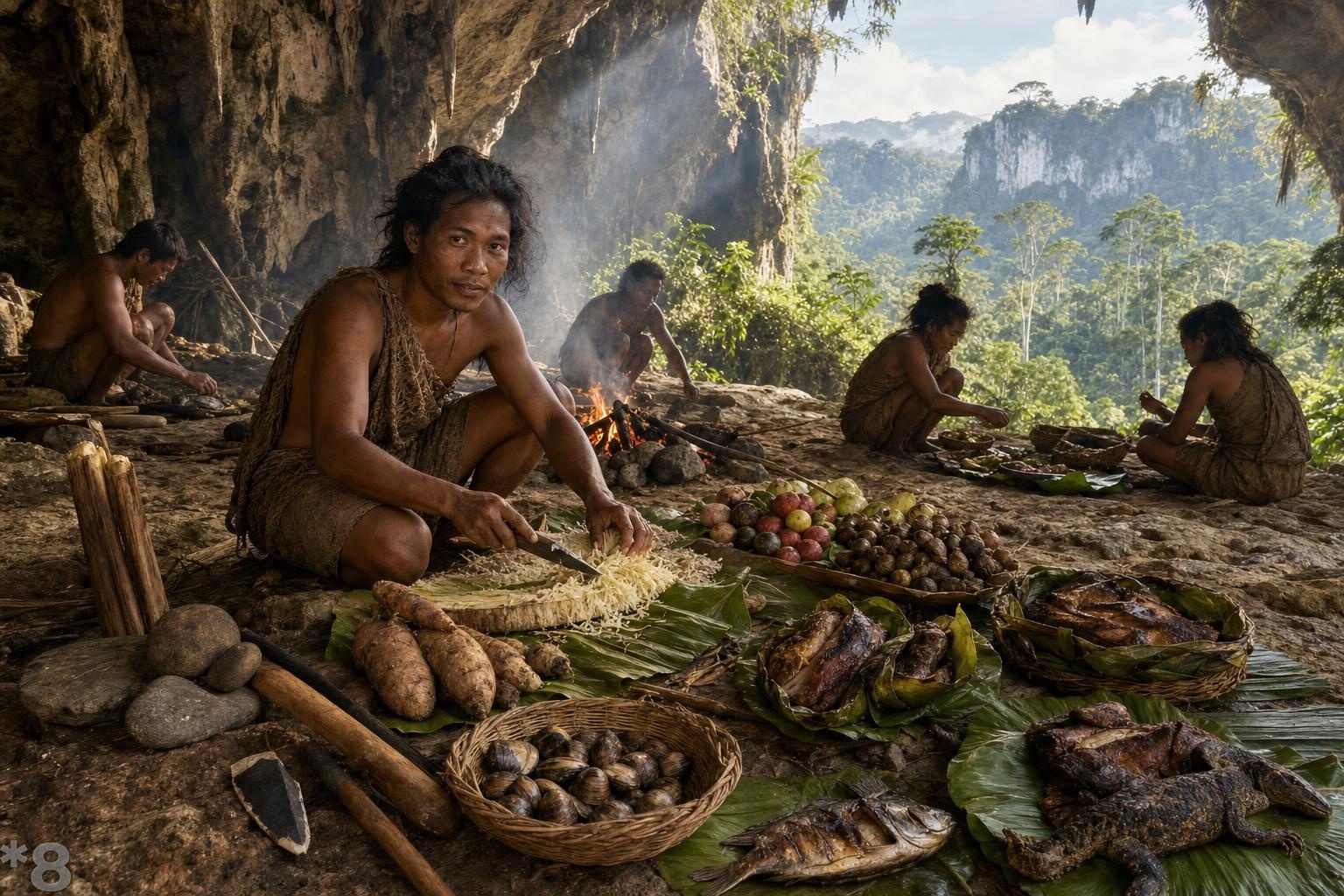
Each case opens with an atlas picture. The pictures are reconstructions generated from each entry's evidence, and the foods laid out in them are the image's choices, not finds. Each case closes with a short list that separates what was observed at the site, what has been inferred from it, and what the evidence cannot show.
The two oldest settings in this chapter frame the problem from opposite directions. At Dmanisi, a small-brained population with simple stone tools lived far from Africa, among unfamiliar animals and formidable carnivores. At Olorgesailie, a single African basin changed beneath its occupants for hundreds of thousands of years. In both places the food evidence is narrower than the stories that have been told about it, and more instructive for being narrow.
Dmanisi: a new continent, an unfamiliar set of animals
Dmanisi is an open-air site on a promontory above the confluence of the Mashavera and Pinasauri rivers in southern Georgia [3]. Stone tools show that hominins used the site repeatedly from shortly after 1.85 million years ago until about 1.78 million years ago, and the hominin fossils date to about 1.77 million years ago [2]. They are among the oldest hominin fossils known outside Africa. The excavators argue that the southern Caucasus was occupied again and again before the fossils accumulated, and that Eurasia was probably occupied before Homo erectus appears in the East African fossil record [2].
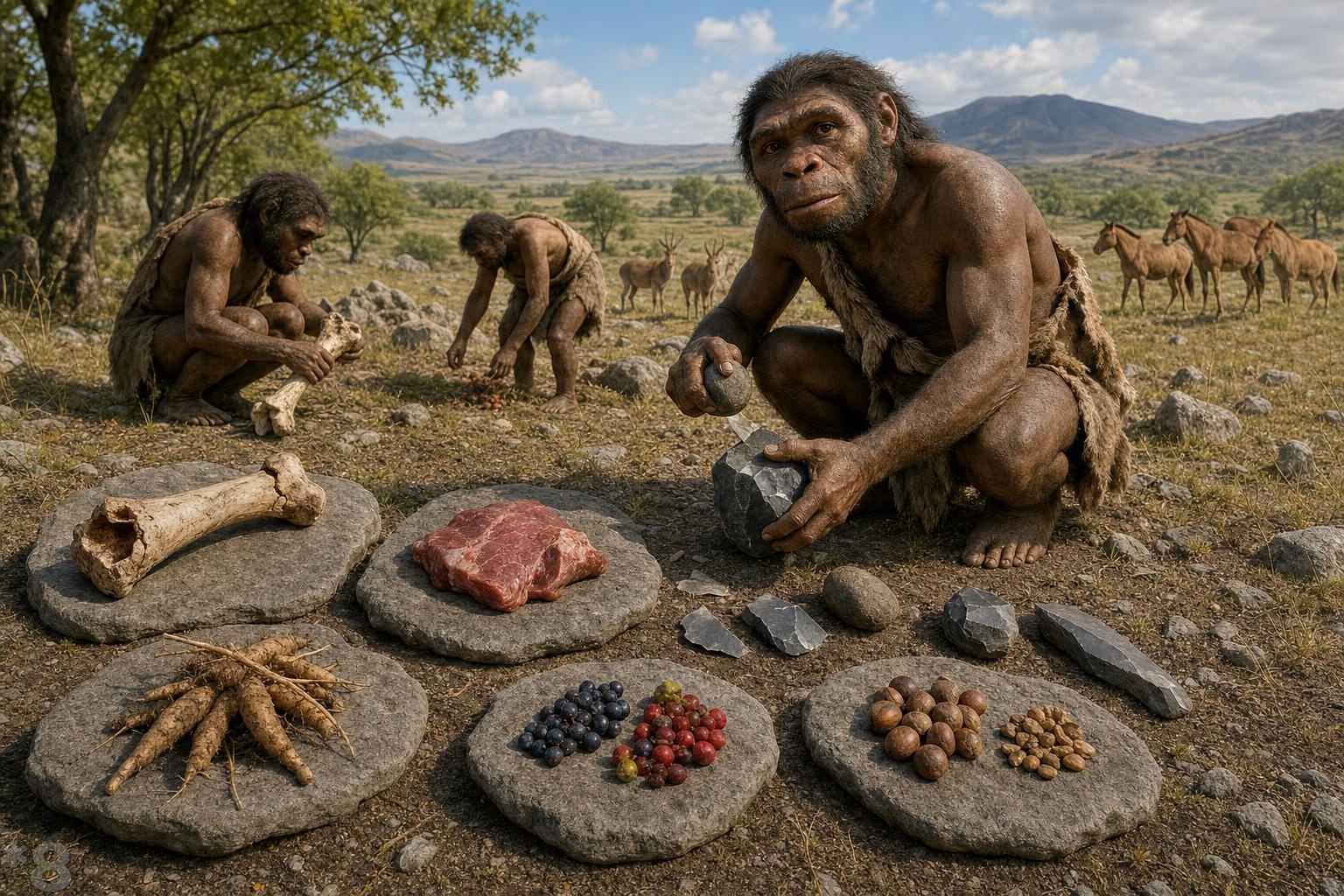
The people were small-brained, with a mixture of primitive and derived skeletal traits [2]. What to call them is still argued over. What matters for food history is that the first well-documented hominins in temperate Eurasia did not arrive with a large brain or a new technology. Their stone tools are simple cores and flakes, Mode 1 in archaeologists' terms [3], the same basic way of making a cutting edge known from earlier African sites.
The landscape was temperate. Pollen, phytoliths and fruit remains describe a forest-steppe [4], and the animals point to both wooded and open ground [3]. Among them were deer, a goat-like bovid called Gallogoral and the southern mammoth, Mammuthus meridionalis [3]. A temperate landscape has seasons, and what a forager could eat in such a place would have changed through the year. Nothing at Dmanisi records how its people managed that.
They were not the only meat-eaters, and they were not the most formidable. The carnivores excavated at Dmanisi include two sabre-toothed cats, Megantereon and Homotherium; a large extinct cat, Panthera gombaszoegensis; a lynx; the giant hyena Pachycrocuta; bears; and the Etruscan wolf, Canis etruscus [3]. An early hunting dog was added to the list in 2021 [5]. Many of these carnivores have Eurasian rather than African roots, and the excavators found no compelling evidence that Dmanisi's mammals arrived from Africa alongside the hominins [3]. A forager here was working an unfamiliar fauna, and competing for it.
The bones were not all put there by hominins
Animal bones are Dmanisi's main food evidence, and three different agents left marks on them. Hominins left stone-tool cut marks, carnivores left tooth marks, and porcupines gnawed some bones [3]. Martha Tappen and colleagues concluded that the excavated areas show too little stone-tool damage for hominins to have been the main collectors of the bones, and too little tooth-scoring for a typical carnivore den [3]. A later spatial study of the B1 deposits in one excavation block, Block 2, reached a firmer verdict: there, carnivores played a major role in accumulating the bone, and hominin activity made only a small contribution [6].
The hominin marks are real but few, and they were counted conservatively, because Dmanisi's bone surfaces are soft and easily scratched during excavation and cleaning [3]. Among the examples the researchers illustrate are cut marks on the shaft of a deer femur, cut marks consistent with filleting meat from a humerus, and percussion striations on a long-bone fragment of the kind left when a bone is broken open for marrow [3]. These are direct traces of carcass processing. They show that hominins at Dmanisi cut meat from bones and broke at least some bones for marrow.
They do not show how the carcasses were obtained. A cut mark looks the same whether the animal was hunted, taken from a carnivore at its kill, or found already dead, and in a place where large carnivores did much of the bone-collecting, each of those routes is plausible. The published evidence does not choose between them.
Teeth, and a person without them
The hominins' teeth add a second, independent line of evidence. Microscopic wear on the chewing surfaces of two Dmanisi molars resembles that of early African Homo erectus [7]. With only two teeth, the authors themselves urge caution, but the result is consistent with continuity: whatever these people ate in the Caucasus did not wear their teeth in a detectably new way [7].
The most cited individual at Dmanisi is a skull and jaw that had lost all but one tooth [8]. The tooth sockets had been resorbed, so the teeth were lost several years before death [8]. The tooth loss would have severely limited chewing, but it does not identify the foods or preparation methods that supported this individual [8]. The describers suggested a diet of soft foods, plant or animal, such as marrow or brain, and raised the possibility that others helped [8]. Both suggestions are reasonable. Neither is demonstrated: the skull records survival, not the meals or the help that made survival possible.
Plant foods are the largest blank. In the studies reviewed here, no plant food has been identified at Dmanisi. The forest-steppe offered plants; whether and how these people ate them is not recorded.
What Dmanisi shows, and what it does not
- Observed: stone-tool cut marks and percussion marks on a small share of the animal bones; carnivore tooth marks and porcupine gnawing on others [3]; microwear on two molars [7]; a skull and jaw that lost nearly all their teeth years before death [8].
- Inferred: that hominins ate the meat and marrow they processed; that the toothless individual lived on soft foods.
- Not shown: how carcasses were obtained; any identified plant food; how much of the diet came from animals.
What Dmanisi establishes is narrower than a menu, and more interesting. A small-brained population with simple stone tools lived, repeatedly, in a temperate landscape far from Africa, among a largely Eurasian fauna [2, 3]. It processed some of those animals for meat and marrow in a place where large carnivores did much of the bone-collecting. The site does not identify which combination of behaviour, anatomy and ecology made that persistence possible, and behaviour is exactly what bones record least well.
Olorgesailie: one basin, many environments
Olorgesailie is a sedimentary basin in the southern Kenya Rift, excavated since 1942 [9]. Its deposits were laid down by lakes, wetlands and rivers between roughly 1.2 million and less than half a million years ago [10], and Acheulean handaxes and other large cutting tools occur through much of that span [11].
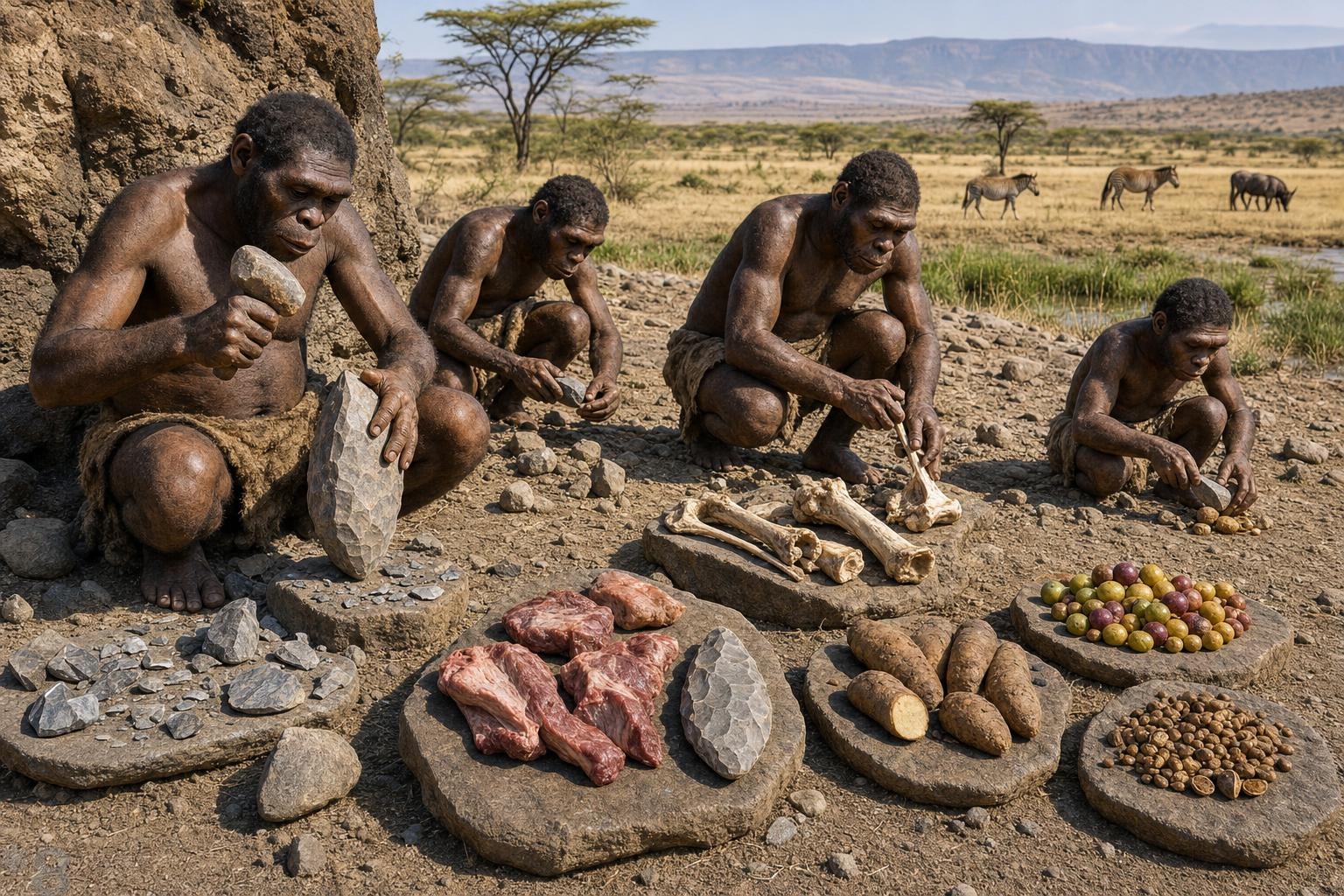
A single place-name covers a very long time. The atlas entry spans 1,200,000 to 320,000 BCE, but the dated archaeology inside that window belongs to separate episodes, and the latest Acheulean tools in the basin date to between 615,000 and 499,000 years ago [11]. Treating the basin's record as one long camp, or one long diet, would compress hundreds of thousands of years of change into one picture.
An elephant, and an argument about geladas
The clearest food event is an elephant. In a layer dated to about 990,000 years ago, excavators found more than 2,300 stone artefacts around the bones of an extinct elephant, Elephas recki [9]. Cut marks on a rib, some of the vertebrae and the hyoid, the small bone that anchors the tongue, record the removal of tissue with stone tools [9]. The marks establish butchery. They do not establish that hominins killed the animal: an elephant found dead or dying would carry the same traces of processing.
Studies of the basin's fauna also report the butchery of other large and dangerous animals, among them a hippopotamus and a giant extinct gelada, Theropithecus oswaldi [10]. The geladas are the basin's most argued-over food. At a locality known as DE/89, excavations recovered the remains of many individuals alongside Acheulean tools. Pat Shipman and colleagues used the animals' mortality profile and comparative patterns of bone breakage to argue for repeated hunting and butchery [12]. Their paper was published with critical comments, and the animals' age structure and mortality were debated further in the same journal [12, 13]. Whether hominins took a troop at once, took animals one by one over a long period, or processed animals that died in other ways is a question about how the bones accumulated, and the bones have not settled it.
The toolmakers are nearly invisible. Hominin fossils from this part of the African record are rare, even where Acheulean tools are abundant [14]. A partial cranium, KNM-OL 45500, dated to between 970,000 and 900,000 years ago and associated with Acheulean handaxes, is possibly the smallest adult or near-adult hominin known from the period between 1.7 million and 500,000 years ago [14]. It shows how varied the hominins of the period were. It says nothing directly about what they ate.
A record of change
What the basin records best is change. As early as 615,000 years ago, Rick Potts and colleagues report, Acheulean toolmakers were choosing stone more selectively and procuring resources more widely, at a time when the shoreline between land and lake was shifting faster [15]. A drill core taken about 24 kilometres away shows that from roughly 400,000 years ago, tectonic, hydrological and ecological changes together disrupted what had been a relatively steady resource base, with growing swings in fresh water, grassland and woody cover [16].
Then the sequence breaks. Between the latest Acheulean, about 499,000 years ago, and the earliest Middle Stone Age, about 320,000 years ago [11], erosion has removed the deposits that would have recorded the transition [16]. When the record resumes, the toolkit is different: prepared cores and points, red pigment worked from iron-rich rock, and stone brought from 25 to 50 kilometres away or farther [17]. The animals are different too. The Middle Stone Age sites sit within a markedly changed mammal community [15], and the fauna found with them suggests a broad strategy that took small prey as well as large [17].
Potts has long argued that environmental instability of this kind selected for adaptability itself, an idea he named variability selection [18]. Olorgesailie fits that hypothesis without proving it. The environmental record and the technological change are dated independently, and the erosional gap removes the very interval in which one would want to watch one follow the other. The drill core's authors present their conclusion as a resource-oriented hypothesis, not a demonstrated cause [16].
A study of the basin's fault lines and animal routes goes further, arguing that the terrain made animal movements predictable enough for ambush hunting [10]. It is a model built from topography, soils and modern grazing patterns, not a kill site, and it should be read as one.
What Olorgesailie shows, and what it does not
- Observed: cut-marked elephant bones among more than 2,300 artefacts, about 990,000 years ago [9]; gelada remains with Acheulean artefacts at DE/89 [12]; a dated change from Acheulean to Middle Stone Age tools, with stone carried 25 to 50 kilometres or more [11, 17]; a changed mammal community and fluctuating water and vegetation [15, 16].
- Inferred: that the butchered animals were eaten; that environmental instability favoured more flexible behaviour [18].
- Not shown: whether the elephant or the geladas were hunted; any identified plant food; a causal sequence across the erosional gap.
For food history, Olorgesailie's lesson is about time. Its published food evidence is animal bone: an elephant and a hippopotamus processed in particular episodes, and a gelada assemblage whose interpretation is still argued. Plant foods, which a basin of lakes, wetlands and woodland could have supplied, have left no comparable trace in the studies cited here. And the people who butchered the elephant 990,000 years ago and the people who carried stone across the rift 320,000 years ago lived in different landscapes, among different animals, roughly 670,000 years apart. A single label, “the diet at Olorgesailie”, would hide all of that.
Liang Bua: an island, and a lizard at the carcass
Liang Bua is a large limestone cave on the Indonesian island of Flores [20]. In its deposits, excavators found the skeleton of an adult hominin about one metre tall, with a brain of about 380 cubic centimetres, as small as the smallest known australopithecines [19]. Its describers assigned it to a new species, Homo floresiensis, and judged the most likely explanation for it to be the long isolation and dwarfing of an ancestral Homo erectus population [19]. That ancestry is still debated [23].
The site's dates have changed, and the change matters for any account of food. The first reports placed H. floresiensis at Liang Bua until at least 18,000 years ago [20]. A revised stratigraphy dates its skeletal remains, and the deposits that contain them, to between about 100,000 and 60,000 years ago, and the stone artefacts attributable to the species to between about 190,000 and 50,000 years ago [21]. A food claim tied to a layer has to say which layer, and whether that layer holds the hominin or only its tools.
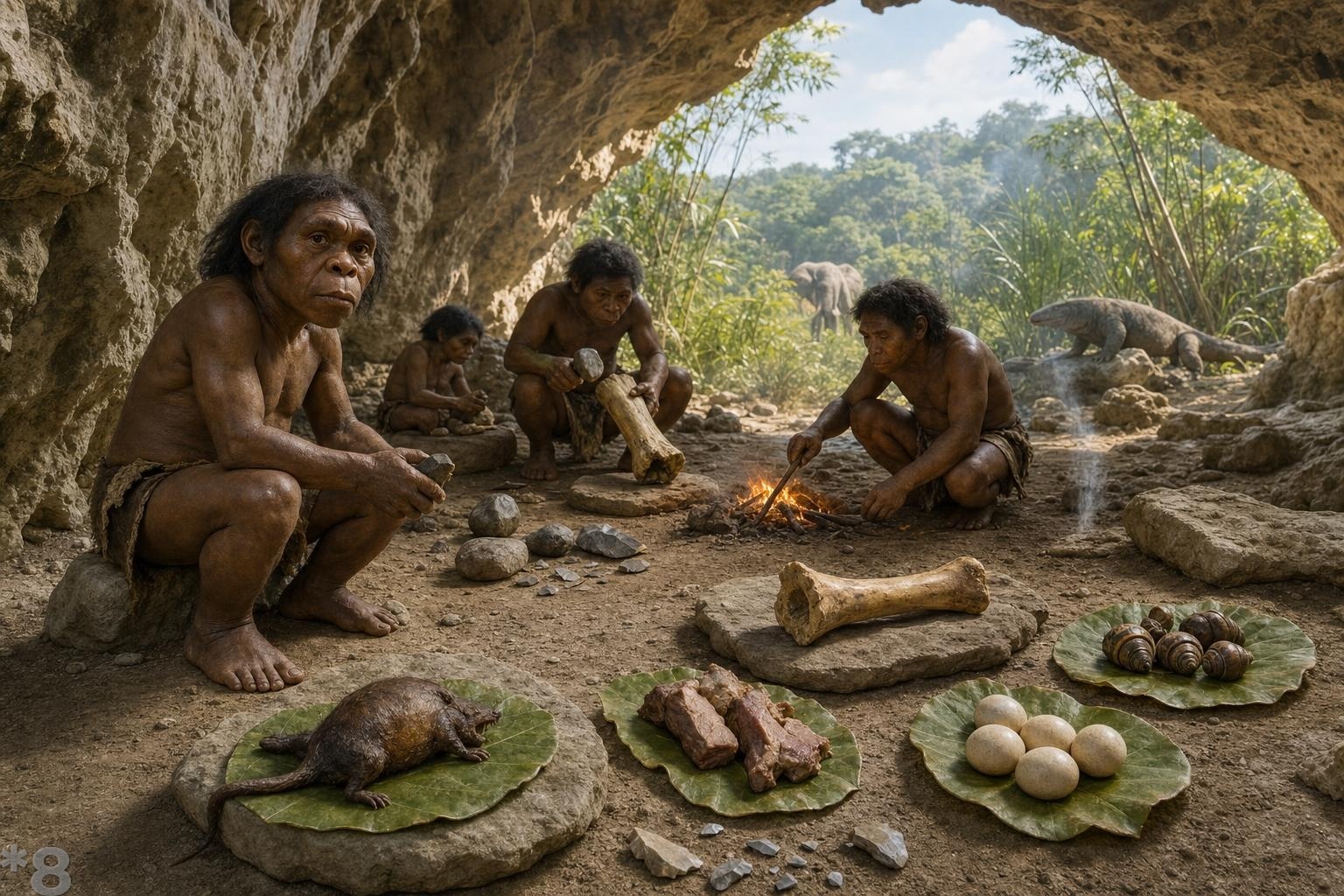
The island's animals were not the mainland's. The deposits that hold H. floresiensis also hold Komodo dragons and an endemic dwarf proboscidean, Stegodon florensis insularis [20, 22], together with a giant marabou stork and a vulture [22]. The hominin, the dwarf Stegodon, the stork and the vulture were probably all extinct at the site by about 50,000 years ago [22].
Prey, or a dragon's leftovers?
For years H. floresiensis was credited with behaviour that seemed out of proportion to its size, including hunting large game and using fire [23]. A systematic taphonomic study published in 2026 tested that against the Stegodon bones themselves. The frequency and placement of predators' marks, and the parts of the skeleton that survive, indicate that Komodo dragons probably had first access to these carcasses, leaving mainly low-value parts for H. floresiensis to scavenge [23]. The same study found no sign of deliberate fire in the layers associated with the species [23].
A 2025 study of rainfall at Liang Bua describes Stegodon as one of the hominins' primary prey [24], but its subject is climate, not carcass access, and it does not test hunting against scavenging as the 2026 study does [23]. Using chemical signals in a dated stalagmite from nearby Liang Luar, its authors modelled a decline in mean annual rainfall from about 1,560 to 990 millimetres between 76,000 and 61,000 years ago, with summer rainfall falling to a record low of about 450 millimetres between 61,000 and 55,000 years ago, while Stegodon remains declined in both number and proportion [24]. They suggest that drying, together with growing competition for dwindling resources, ended the hominins' use of the cave [24].
The two studies describe the hominins' large-animal food differently, and only the 2026 study tested how it was obtained. Read together, they suggest that on a small island its access to that food depended on the island's water and on its other meat-eaters. On a continent a hominin competes with sabre-toothed cats and hyenas; at Liang Bua the competitor that mattered may have been a lizard.
The end of the story belongs to another species. At about 46,000 calibrated radiocarbon years ago, the stone tools at Liang Bua shift abruptly toward chert. If that preference marks Homo sapiens, as earlier studies suggested, modern humans had reached Flores by then [22]. That is after the latest stone tools attributed to H. floresiensis, about 50,000 years ago, and whether the two species ever met on Flores remains an open question [21].
What Liang Bua shows, and what it does not
- Observed: a small-bodied, small-brained hominin whose skeletal remains are about 100,000 to 60,000 years old [19, 21]; dwarf Stegodon, Komodo dragon, giant stork and vulture in the same deposits [20, 22]; the pattern of predator marks and surviving parts on Stegodon bones; no sign of deliberate fire in the hominin layers [23]; geochemical measurements from a dated stalagmite at nearby Liang Luar [24].
- Inferred: that H. floresiensis scavenged Stegodon after Komodo dragons [23]; a decline in rainfall from 76,000 years ago, modelled from the stalagmite; that drying and competition ended its use of the cave [24].
- Not shown: any plant food; how much of the diet came from animals; whether H. floresiensis and modern humans met.
Niah: starch in a rainforest cave
The Niah Caves lie in Sarawak, on the island of Borneo. In 1958, excavators in the West Mouth of the Great Cave found a modern human skull, the “Deep Skull”, whose age was disputed for decades [25]. A re-investigation led by Graeme Barker re-dated the deposits and showed that the skull was not an intrusion from later layers. It belongs with episodes of human activity between about 46,000 and 34,000 years ago [25].
The surroundings were not a fixed rainforest. Over that span the vegetation outside the cave varied between wet lowland forest, montane forest, savannah and grassland, and the shallow basin behind the cave mouth alternated between drying out completely and holding water [25]. The atlas entry's rainforest is accurate for much of the record, not for all of it.
The evidence is microscopic
Niah's most important contribution to food history cannot be seen with the naked eye. Huw Barton extracted starch grains from the cave's Pleistocene occupation sediments and identified several aroids (Alocasia and Cyrtosperma), at least one yam (Dioscorea) and the pith of sago palms [26]. Fourteen recurring types of starch grain point to a wider range of starchy plants still awaiting identification [26]. Barton presented the result as the case for rainforest foragers: direct evidence that people used rainforest plants rich in digestible carbohydrate [26].
Barker's team drew a further conclusion from the starch, plant remains, pollen and scorched sediments. Foraging at Niah, they argue, involved collecting and processing toxic plants for food, hunting methods suited to particular habitats, and perhaps the use of fire at some forest edges [25]. Processing is the important word. A plant that must be made safe before it can be eaten is food only for people who know how. That knowledge leaves almost no trace: the sediments preserve the plant, and the method of preparing it remains an inference.
The animal bones tell a similar story of local knowledge, from a later period. At Lobang Hangus, an east-facing entrance to the Niah complex, bones from the end of the Pleistocene show people taking a variety of animals that lived on the ground, in the trees and in water [27]. The age structure of the main prey species, together with bone points and comparison with modern rainforest hunting, suggests that some form of projectile weapon, and traps, were probably in use [27]. This evidence is more than twenty thousand years younger than the Deep Skull, and should not be read back onto the earliest occupation.
What Niah shows, and what it does not
- Observed: starch grains from aroids, a yam and sago palms in Pleistocene occupation sediments [26]; episodes of human activity 46,000 to 34,000 years ago, amid changing vegetation [25]; at Lobang Hangus, a varied fauna and bone points from the end of the Pleistocene [27].
- Inferred: that the starchy plants were eaten, some after processing to remove toxins [25]; that projectile weapons and traps were used [27].
- Not shown: how the plants were prepared; the share of plants in the diet; whether the earliest occupants hunted as the later ones did.
Niah is the chapter's corrective. Where researchers looked for plant food with methods able to find it, they found it, and it changes the picture that bones alone would draw.
Yana: the Arctic before the Last Glacial Maximum
The Yana site lies on the Yana River in northeastern Siberia, at about 71° north, well above the Arctic Circle [28]. When its excavators reported it in 2004, an age of about 27,000 radiocarbon years BP (¹⁴C BP) made it twice as old as any other known human occupation in the Arctic [28]. People were living there before the Last Glacial Maximum, the coldest phase of the last glacial period [28].
Two children's milk teeth from the site have since yielded genomes about 31,000 calendar years old [29]. They belong to a previously unknown population, which geneticists named the Ancient North Siberians, distantly related to early West Eurasian hunter-gatherers [29].
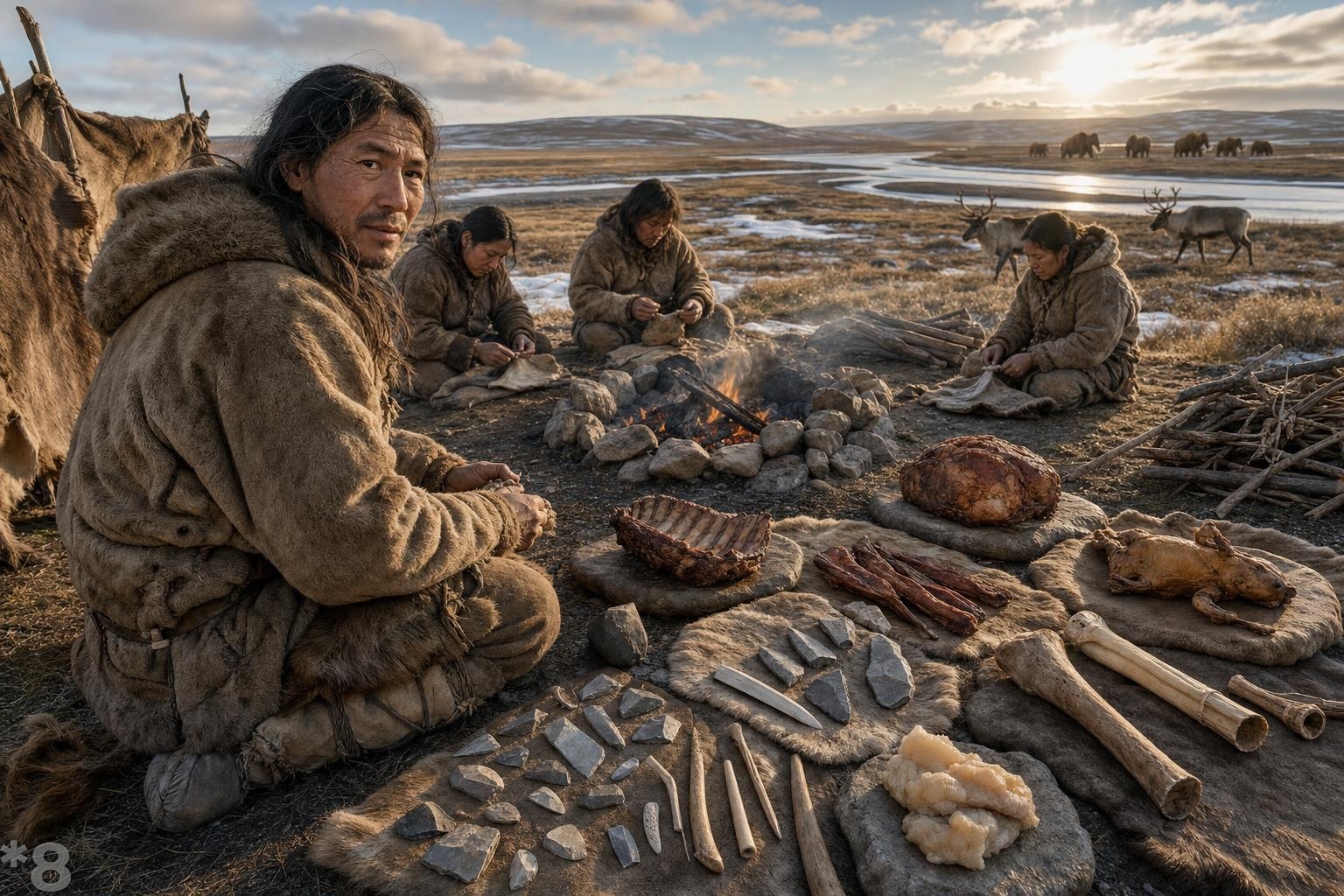
The excavators reported a rare foreshaft made of rhinoceros horn, other foreshafts made from mammoth, and a wide range of tools and flakes [28]. These were people equipped to live, at least for a time, in one of the harshest environments humans had then entered.
Mammoths, and what they were for
The mammoth remains document both hunting and the use of mammoths as raw material. Excavations since 2008 have recovered 1,103 bones from at least 31 mammoths, accumulated over roughly 2,000 years [31] and dated in the primary study to about 29,000–27,000 ¹⁴C BP [30]; press coverage gave this as roughly 33,500 to 31,500 years ago [31]. Five mammoth hyoid bones found in occupation areas, away from the main accumulation, were interpreted as evidence that fresh tongues were carried there [30]. Fragments of stone points are lodged in the right shoulder blades of two animals, and other bones carry what the researchers interpret as spear wounds, struck from behind [31]. Embedded weapon tips are direct evidence that people attacked these animals.
Why they did so is a separate question. Pavel Nikolskiy and Vladimir Pitulko argue that the hunting was occasional, every few years, and aimed chiefly at ivory, which served as a raw material for tools on a tundra with few trees. In their reading, meat was eaten but was not the main purpose [30, 31]. Other archaeologists point out that at some European sites mammoth bones are numerous enough to suggest that people sought meat, fat, bone and skin as well [31]. The disagreement is a useful reminder that an animal could matter to Paleolithic people for more than food.
What Yana does not provide is a menu. The sources reviewed here do not establish whether people stayed through the Arctic winter or came seasonally, and they identify no plant food.
What Yana shows, and what it does not
- Observed: human occupation at about 71° north, dated to about 27,000 ¹⁴C BP [28]; five mammoth hyoid bones in occupation areas [30]; foreshafts of rhinoceros horn and mammoth [28]; at least 31 mammoths, two with stone point fragments in their shoulder blades [30, 31]; genomes from two milk teeth [29].
- Inferred: that mammoths were hunted mainly for ivory, and only every few years; that tongues were carried to the occupation areas [30].
- Not shown: whether the site was occupied year-round; any plant food; how meat was prepared.
A timeline of the five places
Radiocarbon ages are labelled ¹⁴C BP and calibrated calendar ages cal BP, both counted from 1950; the two scales are not interchangeable. Other ages are rounded estimates from the cited studies.
- About 1.85 to 1.78 million years ago: repeated hominin use of Dmanisi; the fossils date to about 1.77 million years ago [2].
- About 990,000 years ago: an elephant butchered at Olorgesailie [9]; a small hominin cranium there dates to between 970,000 and 900,000 years ago [14].
- 615,000 to 499,000 years ago: the late Acheulean at Olorgesailie, followed after a gap by the Middle Stone Age, by about 320,000 years ago [11].
- About 190,000 to 50,000 years ago: stone tools attributable to H. floresiensis at Liang Bua; its skeletal remains date to about 100,000 to 60,000 years ago [21].
- About 46,000 to 34,000 years ago: episodes of human activity at Niah [25].
- About 29,000 to 27,000 ¹⁴C BP: mammoth remains accumulate at Yana, over roughly 2,000 years [30, 31].
Five places, five problems
Set side by side, the five places do not add up to a Paleolithic diet. They add up to five different problems. At Dmanisi the problem was an unfamiliar continent shared with large carnivores. At Olorgesailie it was a basin whose lakes, plants and animals kept changing. At Liang Bua it was a small island where a giant lizard may have reached the carcasses first. At Niah it was a forest whose starchy plants had to be found and, in some cases, made safe to eat. At Yana it was an Arctic where animals supplied raw materials as well as food.
What links them is not a menu but a way of reading. Each site preserves some kinds of evidence and loses others. At four of the five, bone is the main food evidence, and where bone is the only witness, diets look meatier than they may have been. Niah, where starch grains were looked for and found, shows how much a different method can add. And the same distinctions recur at every site: between an animal's presence and its use, between processing a carcass and killing the animal, between a hominin's tools and its meals.
The chapters that follow take those distinctions one at a time: plants, then animals, then fire and processing, and finally the limits of the evidence itself.
What remains uncertain
At four of the five sites the food record is chiefly animal bone, and at none of them can the share of animal and plant food in the diet be measured. At Dmanisi the share of the bones that hominins handled is small, and how they obtained carcasses is unknown. At Olorgesailie, whether the elephant and the geladas were hunted is unresolved, and the sequence breaks where environmental and technological change might have been seen together. At Liang Bua, the only direct test of carcass access points to scavenging, while a climate study treats Stegodon as prey without testing it. At Niah, the plants are identified but their preparation is not. At Yana, the purpose of mammoth hunting is argued, and the season of occupation is unknown.
| Claim | What supports it | Label | Sources |
|---|---|---|---|
| Hominins at Dmanisi cut meat from bones and broke some for marrow. | Cut marks and percussion striations on a small share of bones, identified conservatively. | Strong | 3 |
| In the B1 deposits of Dmanisi's Block 2, carnivores contributed substantially to the bone accumulation and hominins much less. | Taphonomic and spatial analysis. | Moderate | 3, 6 |
| An elephant was butchered at Olorgesailie about 990,000 years ago. | Cut-marked rib, vertebrae and hyoid among more than 2,300 artefacts, as reported by the excavating programme. | Moderate | 9 |
| Environmental instability at Olorgesailie favoured more flexible behaviour. | Independently dated records on either side of an erosional gap. | Interpretive | 15, 16, 18 |
| H. floresiensis scavenged Stegodon after Komodo dragons had fed. | Predator marks and skeletal-part profiles; a 2025 climate study treats Stegodon as prey without testing it. | Probable | 23, 24 |
| Niah occupants used starchy plants for food, some after processing. | Starch identifications and archaeological context; consumption and detoxification are interpretations. | Probable | 25, 26 |
| People at Yana attacked mammoths with stone-tipped weapons. | Point fragments lodged in shoulder blades; the ivory motive is the excavators' reading. | Strong | 30, 31 |
| Hominins at Olorgesailie hunted the geladas at DE/89. | Mortality profile and bone-breakage patterns argued as hunting and butchery; the reading is disputed. | Insufficient evidence | 12, 13 |
Sources
- Harmand, S., Lewis, J. E., Feibel, C. S., et al. (2015). “3.3-million-year-old stone tools from Lomekwi 3, West Turkana, Kenya.” Nature 521, 310–315. DOI: https://doi.org/10.1038/nature14464
- Ferring, R., Oms, O., Agustí, J., et al. (2011). “Earliest human occupations at Dmanisi (Georgian Caucasus) dated to 1.85–1.78 Ma.” Proceedings of the National Academy of Sciences 108, 10432–10436. DOI: https://doi.org/10.1073/pnas.1106638108
- Tappen, M., Lordkipanidze, D., Bukhsianidze, M., Ferring, R., & Vekua, A. (2007). “Are you in or out (of Africa)? Site formation at Dmanisi and actualistic studies in Africa.” In T. R. Pickering, K. Schick & N. Toth (eds), Breathing Life into Fossils: Taphonomic Studies in Honor of C. K. (Bob) Brain. Stone Age Institute Press. Full text: https://www.stoneageinstitute.org/pdfs/breathing-fossils-ch7-tappen.pdf
- Messager, E., Lebreton, V., Marquer, L., et al. (2011). “Palaeoenvironments of early hominins in temperate and Mediterranean Eurasia: new palaeobotanical data from Palaeolithic key-sites and synchronous natural sequences.” Quaternary Science Reviews 30, 1439–1447. DOI: https://doi.org/10.1016/j.quascirev.2010.09.008
- Bartolini-Lucenti, S., Madurell-Malapeira, J., Martínez-Navarro, B., Palmqvist, P., Lordkipanidze, D., & Rook, L. (2021). “The early hunting dog from Dmanisi with comments on the social behaviour in Canidae and hominins.” Scientific Reports 11, 13501. DOI: https://doi.org/10.1038/s41598-021-92818-4
- Coil, R., Tappen, M., Ferring, R., Bukhsianidze, M., Nioradze, M., & Lordkipanidze, D. (2020). “Spatial patterning of the archaeological and paleontological assemblage at Dmanisi, Georgia: An analysis of site formation and carnivore-hominin interaction in Block 2.” Journal of Human Evolution 143, 102773. DOI: https://doi.org/10.1016/j.jhevol.2020.102773
- Pontzer, H., Scott, J. R., Lordkipanidze, D., & Ungar, P. S. (2011). “Dental microwear texture analysis and diet in the Dmanisi hominins.” Journal of Human Evolution 61, 683–687. DOI: https://doi.org/10.1016/j.jhevol.2011.08.006
- Lordkipanidze, D., Vekua, A., Ferring, R., et al. (2005). “The earliest toothless hominin skull.” Nature 434, 717–718. DOI: https://doi.org/10.1038/434717b
- Smithsonian Institution, Human Origins Program. “Olorgesailie, Kenya.” Updated 8 July 2024. https://humanorigins.si.edu/research/east-african-research-projects/olorgesailie-kenya
- Kübler, S., Owenga, P., Reynolds, S. C., et al. (2015). “Animal movements in the Kenya Rift and evidence for the earliest ambush hunting by hominins.” Scientific Reports 5, 14011. DOI: https://doi.org/10.1038/srep14011
- Deino, A. L., Behrensmeyer, A. K., Brooks, A. S., et al. (2018). “Chronology of the Acheulean to Middle Stone Age transition in eastern Africa.” Science 360, 95–98. DOI: https://doi.org/10.1126/science.aao2216
- Shipman, P., Bosler, W., & Davis, K. L. (1981). “Butchering of giant geladas at an Acheulian site.” Current Anthropology 22, 257–268, with comments and reply. DOI: https://doi.org/10.1086/202663
- “More on Theropithecus at Olorgesailie: Age Structure and Mortality.” (1982). Current Anthropology 23, 349–352. DOI: https://doi.org/10.1086/202859 (author pending verification).
- Potts, R., Behrensmeyer, A. K., Deino, A., Ditchfield, P., & Clark, J. (2004). “Small mid-Pleistocene hominin associated with East African Acheulean technology.” Science 305, 75–78. DOI: https://doi.org/10.1126/science.1097661
- Potts, R., Behrensmeyer, A. K., Faith, J. T., et al. (2018). “Environmental dynamics during the onset of the Middle Stone Age in eastern Africa.” Science 360, 86–90. DOI: https://doi.org/10.1126/science.aao2200
- Potts, R., Dommain, R., Moerman, J. W., et al. (2020). “Increased ecological resource variability during a critical transition in hominin evolution.” Science Advances 6, eabc8975. DOI: https://doi.org/10.1126/sciadv.abc8975
- Brooks, A. S., Yellen, J. E., Potts, R., et al. (2018). “Long-distance stone transport and pigment use in the earliest Middle Stone Age.” Science 360, 90–94. DOI: https://doi.org/10.1126/science.aao2646
- Potts, R. (1998). “Variability selection in hominid evolution.” Evolutionary Anthropology 7, 81–96. DOI: 10.1002/(SICI)1520-6505(1998)7:3<81::AID-EVAN3>3.0.CO;2-A
- Brown, P., Sutikna, T., Morwood, M. J., et al. (2004). “A new small-bodied hominin from the Late Pleistocene of Flores, Indonesia.” Nature 431, 1055–1061. DOI: https://doi.org/10.1038/nature02999
- Morwood, M. J., Soejono, R. P., Roberts, R. G., et al. (2004). “Archaeology and age of a new hominin from Flores in eastern Indonesia.” Nature 431, 1087–1091. DOI: https://doi.org/10.1038/nature02956
- Sutikna, T., Tocheri, M. W., Morwood, M. J., et al. (2016). “Revised stratigraphy and chronology for Homo floresiensis at Liang Bua in Indonesia.” Nature 532, 366–369. DOI: https://doi.org/10.1038/nature17179
- Sutikna, T., Tocheri, M. W., Faith, J. T., et al. (2018). “The spatio-temporal distribution of archaeological and faunal finds at Liang Bua (Flores, Indonesia) in light of the revised chronology for Homo floresiensis.” Journal of Human Evolution 124, 52–74. DOI: https://doi.org/10.1016/j.jhevol.2018.07.001
- Veatch, E. G., Alamsyah, N., Pante, M., et al. (2026). “Taphonomic analysis at Liang Bua reveals the behavioral and technological capabilities of Homo floresiensis.” Science Advances 12, eaeb7219. DOI: https://doi.org/10.1126/sciadv.aeb7219
- Gagan, M. K., Ayliffe, L. K., Puspaningrum, M. R., et al. (2025). “Onset of summer aridification and the decline of Homo floresiensis at Liang Bua 61,000 years ago.” Communications Earth & Environment 6, 992. DOI: https://doi.org/10.1038/s43247-025-02961-3
- Barker, G., Barton, H., Bird, M., et al. (2007). “The ‘human revolution’ in lowland tropical Southeast Asia: the antiquity and behavior of anatomically modern humans at Niah Cave (Sarawak, Borneo).” Journal of Human Evolution 52, 243–261. DOI: https://doi.org/10.1016/j.jhevol.2006.08.011
- Barton, H. (2005). “The case for rainforest foragers: the starch record at Niah Cave, Sarawak.” Asian Perspectives 44, 56–72. DOI: https://doi.org/10.1353/asi.2005.0005
- Piper, P. J., & Rabett, R. J. (2009). “Hunting in a tropical rainforest: evidence from the Terminal Pleistocene at Lobang Hangus, Niah Caves, Sarawak.” International Journal of Osteoarchaeology 19, 551–565. DOI: https://doi.org/10.1002/oa.1046
- Pitulko, V. V., Nikolsky, P. A., Girya, E. Yu., et al. (2004). “The Yana RHS site: humans in the Arctic before the Last Glacial Maximum.” Science 303, 52–56. DOI: https://doi.org/10.1126/science.1085219
- Sikora, M., Pitulko, V. V., Sousa, V. C., et al. (2019). “The population history of northeastern Siberia since the Pleistocene.” Nature 570, 182–188. DOI: https://doi.org/10.1038/s41586-019-1279-z
- Nikolskiy, P., & Pitulko, V. (2013). “Evidence from the Yana Palaeolithic site, Arctic Siberia, yields clues to the riddle of mammoth hunting.” Journal of Archaeological Science 40, 4189–4197. DOI: https://doi.org/10.1016/j.jas.2013.05.020
- Bower, B. (2013). “Ancient Siberians may have rarely hunted mammoths.” Science News, 12 June 2013. https://www.sciencenews.org/article/ancient-siberians-may-have-rarely-hunted-mammoths
In the atlas
Spot something wrong in this article?