
The First Bread: Before Agriculture
The oldest direct evidence for bread comes from a hunter-gatherer camp in Jordan about 14,400 years ago, at least four millennia before farming. Older grinding tools show that plants were processed, not that bread was made, and bread most likely became an everyday food only after agriculture.
A charred crumb from the Black Desert
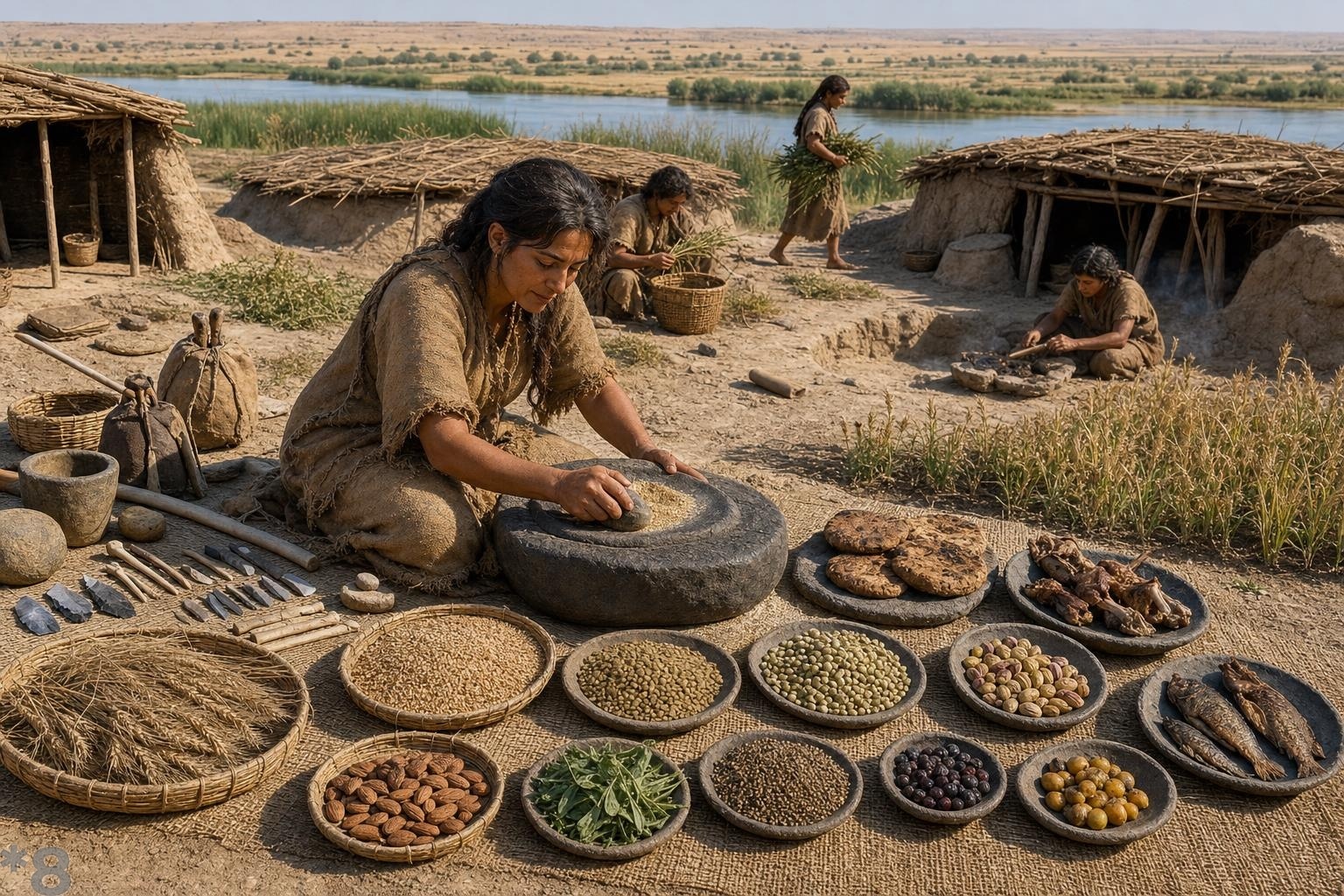
The oldest direct evidence currently identified for bread-like food comes not from a farming village but from a hunter-gatherer camp in northeastern Jordan. At Shubayqa 1, archaeologists recovered charred food remains from a Natufian context. Microscopic examination led Amaia Arranz-Otaegui and colleagues to identify 24 of the fragments as the remains of probably flat, bread-like products. The site’s occupation falls within 14.6–11.6 thousand calibrated years before present (ka cal BP); the researchers date the bread-like finds to approximately 14,400 years ago. This is at least four millennia before agriculture became established in the region [1].
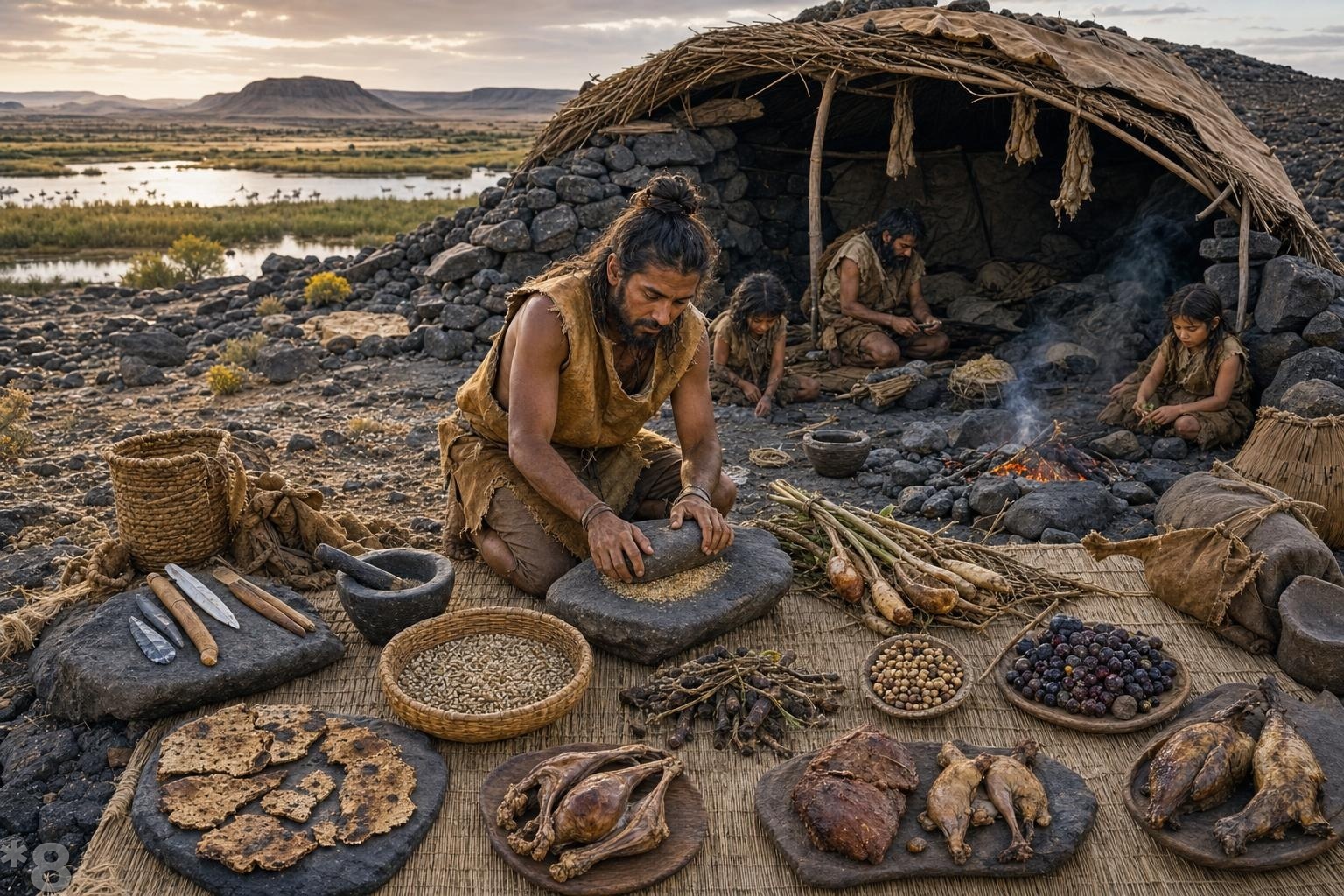
These fragments matter because they are food residues, rather than tools that might have been used to make food. Their porous structure and embedded plant tissues allowed researchers to examine what had actually been prepared. The study suggests wild einkorn wheat and club-rush tubers among the ingredients. These were not modern bakery loaves, and their surviving structure cannot recover a complete recipe. Nevertheless, the fragments demonstrate that people combined and processed plant ingredients into something recognizable as a flat bread-like food before domesticated cereals became the basis of farming [1].
The distinction between direct remains and reconstruction is fundamental. The carbonized pieces are excavated objects. Their identification as bread-like food rests on microscopic comparisons and interpretation of their internal structure. How often people prepared them, precisely how they mixed the ingredients, and what the finished pieces looked like beyond their surviving fragments are less secure. A reconstruction may suggest a plausible flatbread, but it cannot turn missing details into archaeological observations.
Shubayqa therefore answers a narrower—and more useful—question than “who invented bread?” It demonstrates that a bread-like product existed among some pre-agricultural communities. It does not establish the first occasion on which anyone baked dough, or show that bread was already eaten every day.
A grinding stone is not a loaf
Long before the Shubayqa fragments, people were processing edible grasses and other plants. Yet each older discovery changes the question being answered. A starch grain trapped on a stone tool can reveal contact with a plant. It cannot, by itself, establish that the plant was ground into flour, mixed into dough, or baked.
At a Middle Stone Age site in Mozambique, Julio Mercader reported starch residues from grass seeds, including sorghum, on stone tools from deposits spanning 105,000–42,000 years ago [7]. The finding pushes evidence for exploitation of grass seeds deep into the Pleistocene. It is important precisely because it does not require bread to be important. Seeds could have been crushed, chewed, cooked in another form, or processed for purposes that the residue cannot distinguish. The claim that these people were bakers would require an additional, absent line of evidence.
Much later, at Grotta Paglicci in southern Italy, researchers found oat starch on a pestle-grinder dating to around 32,600 cal BP. Mariotti Lippi and colleagues interpreted the residues as evidence of multiple processing stages, with heating before grinding among the possibilities [4]. That sequence is more informative than the mere presence of starch: it points toward intentional treatment of a food plant. But neither a prepared grain nor a grinding implement is a preserved bread product.
A broader study by Anna Revedin and colleagues examined grinding tools from Bilancino II in Italy, Kostenki 16-Uglyanka in Russia, and Pavlov VI in the Czech Republic. The researchers identified starches from wild plants and interpreted the residues and tool wear as evidence of flour production around 30,000 years ago [3]. The geographical spread makes plant grinding difficult to dismiss as an isolated experiment. It does not make the resulting foods identical across the three sites. Their interpretation of flour production is not a license to picture bread emerging from each tool.
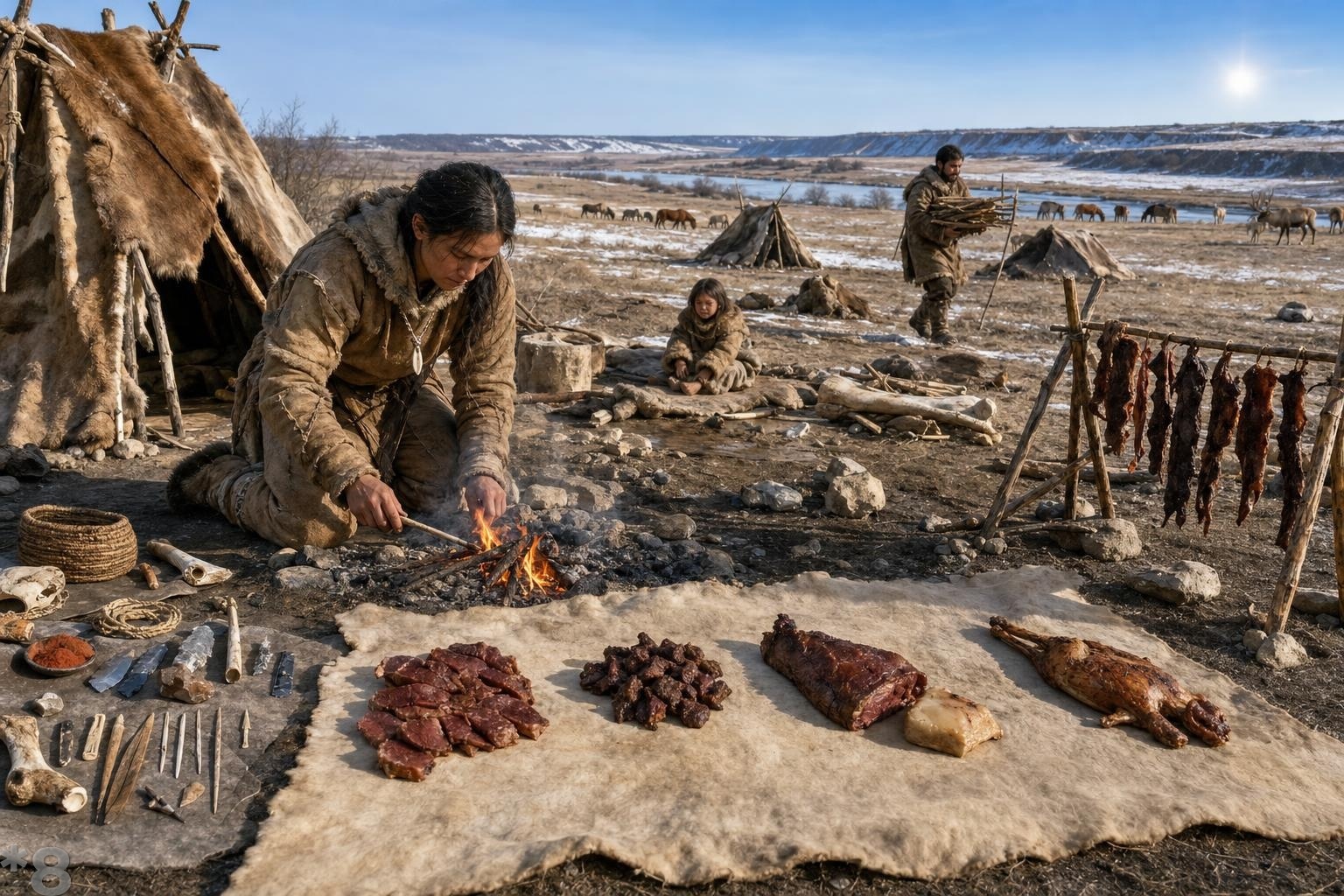
These discoveries are sometimes assembled into a continuous history of bread. They are better understood as evidence for separate capacities: collecting edible seeds, altering them, grinding plant material, and perhaps producing flour. Bread requires further operations. An archaeological sequence can show that those operations became possible long before it can show that they were performed together.
Ohalo II: flour, a hearth, and an inference
At Ohalo II, on the shore of the Sea of Galilee in present-day Israel, exceptional preservation has opened an unusually detailed view of plant use about 23,000 years ago. Researchers identified barley starch, and possibly wheat starch, on a ground stone. Nearby was a feature described as an oven-like hearth. Dolores Piperno and colleagues argued that the combination suggested the preparation of dough and its baking [2]. The language matters: starch on the stone is a material observation; baking dough is an interpretation of the stone and hearth in association.
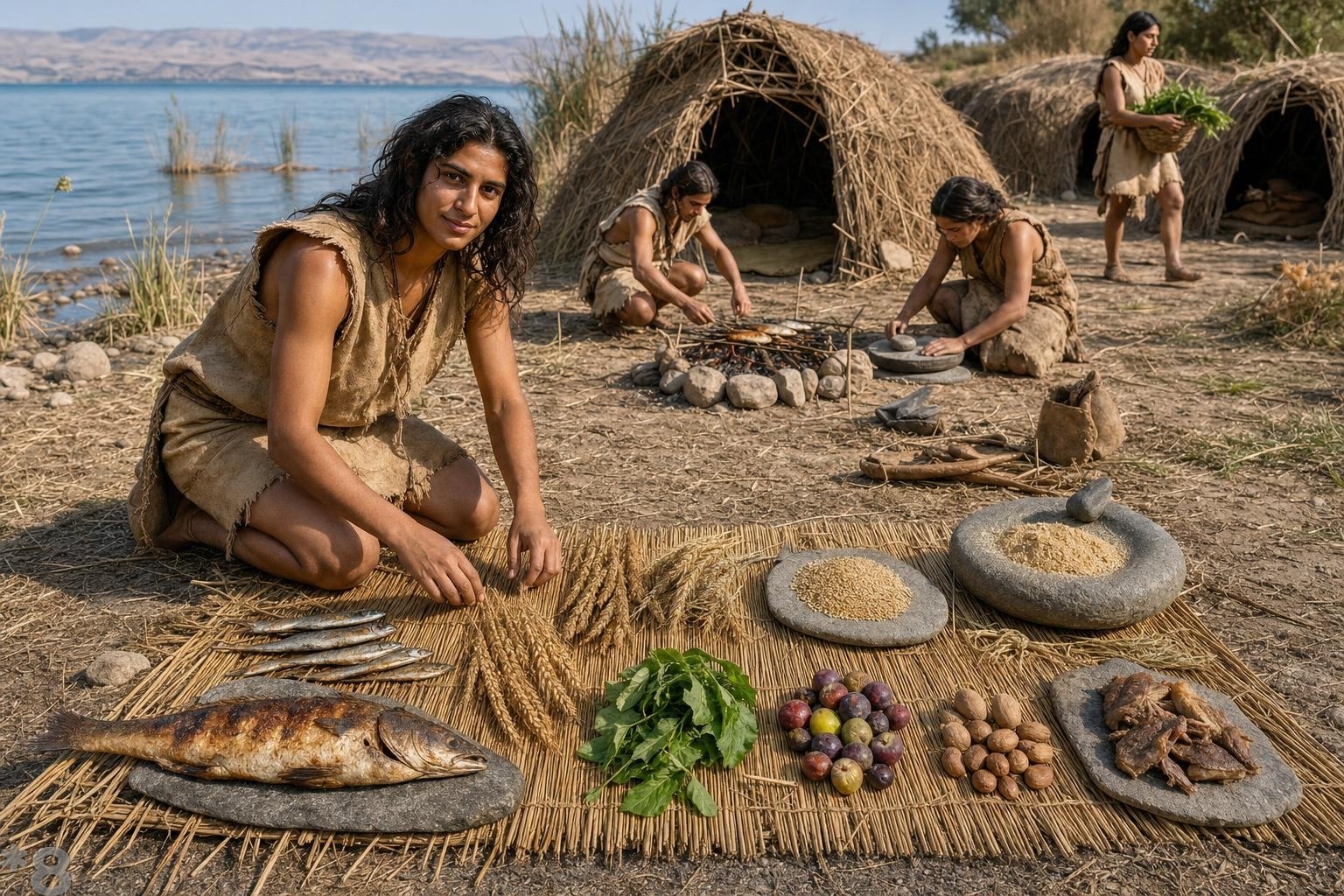
Ohalo II also yielded a remarkably rich botanical assemblage. In a separate analysis, Ehud Weiss and colleagues examined more than 90,000 plant remains and concluded that wild grasses were staple plant resources for the occupants [5]. This supports a substantial reliance on gathered seeds rather than an incidental encounter with a few cereal grains. It does not mean that all those seeds became bread. Grinding could support several food preparations, and even a frequently consumed grain need not be consumed as a baked product.
Another study of the site, by Ainit Snir and colleagues, examined approximately 150,000 plant specimens representing more than 140 species. The authors reported thirteen species interpreted as proto-weeds and proposed that the assemblage indicated small-scale trial cultivation long before the Neolithic farming transition [6]. That proposal is provocative because it separates experimenting with plant growth from the much later appearance of fully agricultural economies. Yet it remains an interpretation of ecological and archaeological patterns, not a direct record of sowing. The evidence does not justify calling Ohalo II a farming village.
Taken together, Ohalo II reveals an economy in which wild cereals could be important, plant processing was practiced, and a baking interpretation is plausible. It is one of the strongest pre-Shubayqa contexts for considering early dough-based food. But no surviving piece of bread from Ohalo II plays the role that the charred Shubayqa fragments do. A convincing hearth and a cereal-stained stone remain different evidence from a charred crumb.
Natufian kitchens: a food that demanded work
The Natufian communities of southwest Asia occupied a world between mobile foraging and the first established agricultural settlements. Their plant-food technologies included equipment capable of pounding and grinding. Shubayqa shows that at least one such community used this technological repertoire to make a bread-like food [1]. It does not follow that all Natufian households made the same food or that every settlement has yielded bread remains.
The steps implied by the Shubayqa material required decisions and labor. Wild cereal grains and underground plant organs had to be obtained and prepared. At least some plant material was reduced sufficiently to become part of a cohesive, heat-treated product. The precise sequence is reconstructed rather than witnessed: surviving fragments do not establish whether ingredients were soaked, how long they were worked, or exactly what cooking surface was used. The study supports the existence of a finished food, not a complete operational manual [1].
Arranz-Otaegui and colleagues also caution against assuming that bread was an ordinary staple in the Natufian period. Their interpretation is that cereal exploitation was not generally common enough to make cereal foods such as bread dietary mainstays, and that bread likely became a staple only after agriculture was established [1]. This is a regional and chronological argument about prevalence, not a direct count of Natufian meals. Archaeologists rarely possess the denominator that such a count would require: how many meals were eaten and left no recognizable trace.
One possible explanation for making a demanding cereal food before farming is that it had value in particular social situations. But assigning Shubayqa bread to feasts, rituals, or celebrations would go beyond what the cited fragments demonstrate. It is safer to say that bread-making was possible and practiced, while its frequency and social setting remain uncertain. The distinction protects an interesting possibility from hardening into an unsupported fact.
Other Natufian settlements, including Eynan, help place these practices in the history of increasingly substantial forager communities. They should not be presented as additional bread-discovery sites without their own direct evidence. Shubayqa is not a stand-in for every Natufian kitchen.
From occasional to everyday: cultivation and domestication
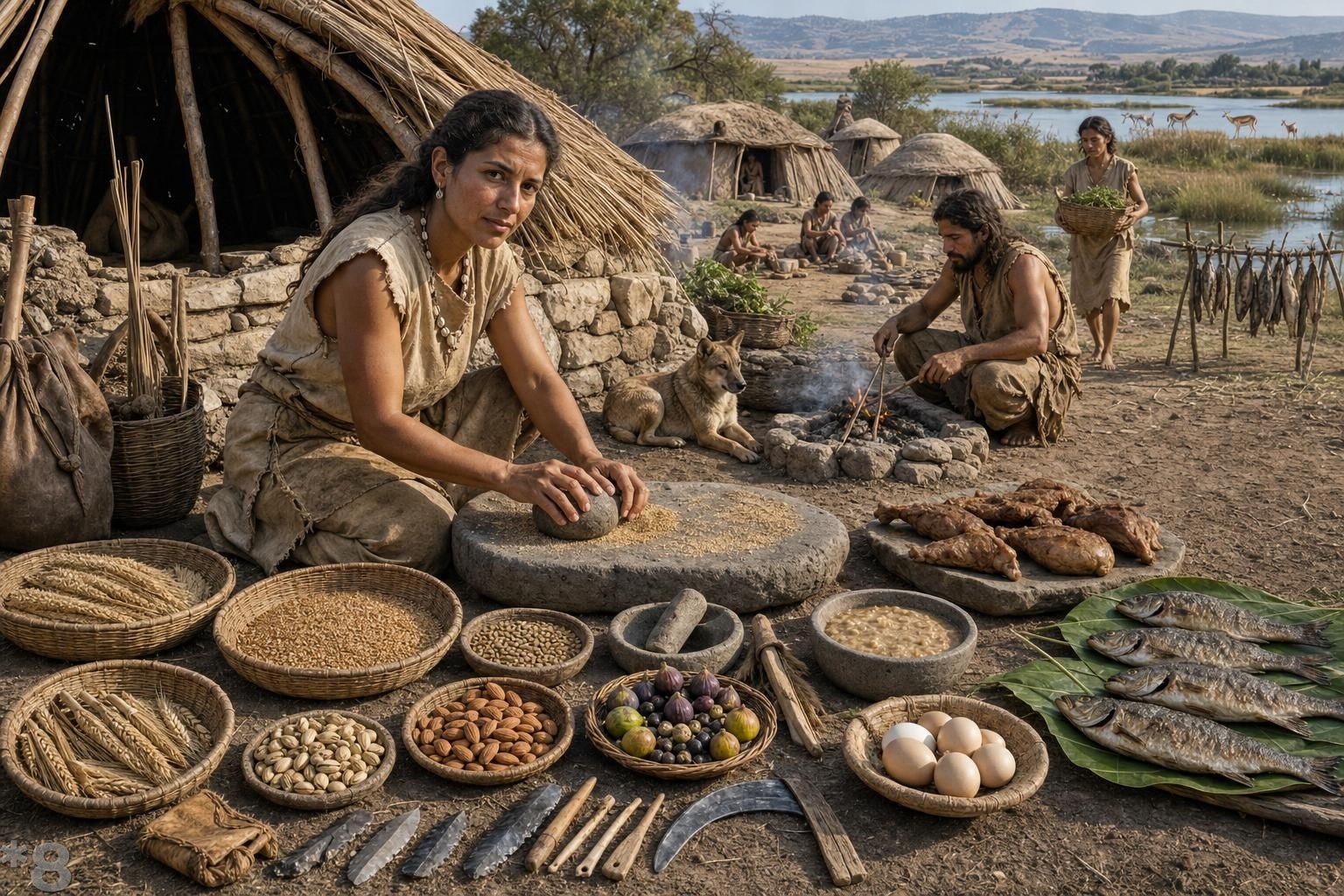
The later agricultural transition did not suddenly invent the idea of grinding grain. It changed the scale, reliability, and social organization of access to cereals. Cultivating wild stands could increase control over supply before plants displayed the morphological traits archaeologists use to recognize domestication. This is why the beginnings of cultivation and the appearance of domesticated-type cereals should not be given a single date.
In a regional comparison, Arranz-Otaegui and colleagues found substantial variation across southwest Asia. Their analysis places cultivation of wild cereals in parts of the southern-central Levant and Upper Euphrates during the Pre-Pottery Neolithic A, while significant proportions of domesticated-type cereal chaff appear in southern Syria around 10.7–10.2 ka cal BP [8]. Those figures refer to particular archaeological indicators and regions, not to a universal moment when humanity became agricultural. Different communities adopted, intensified, or abandoned practices on different schedules.
The distinction also changes the story of bread. The skills required to process plants were already ancient. At Shubayqa, a bread-like product already existed. Agriculture did not need to invent either grinding or baking from nothing. It could, however, make cereal foods more dependable by increasing the quantities of grain available and embedding cereal cultivation within recurring household and community work. This is an explanatory inference consistent with the authors’ conclusion that bread probably became a staple with agriculture [1, 8], rather than a directly measured curve of bread consumption.
Sites such as Abu Hureyra, Jericho, and later Çatalhöyük belong in this broader comparison, but they represent different places and periods. Their atlas entries should not be treated as interchangeable evidence for the origins of bread. To make a claim about a particular site’s cereals, ovens, or household diet requires a site-specific study. Chronological proximity alone cannot transfer a finding from one excavation to another.
How archaeologists tell bread from porridge
Why is the earliest bread so hard to identify? Cooking transforms plant tissues. Grinding removes many recognizable seed shapes, heating alters starch and other structures, and charring can preserve a food while also deforming it. Archaeologists may find a blackened lump whose ingredients and original texture are not immediately apparent. Calling every cereal-rich lump “bread” would erase meaningful differences between foods.
Researchers therefore examine the fragments themselves, using microscopy and comparison with experimentally prepared foods. González Carretero, Wollstonecroft, and Fuller developed a methodological approach to archaeological cereal meals using material from Çatalhöyük East as a case study [9]. These comparisons support probable identifications of dough, bread-like and porridge-like preparations, while some structures remain without an experimental analogue [9]. The important methodological point is that the identification is an analysis of structure and plant traces, not a judgment based on whether a charred object resembles a modern loaf.
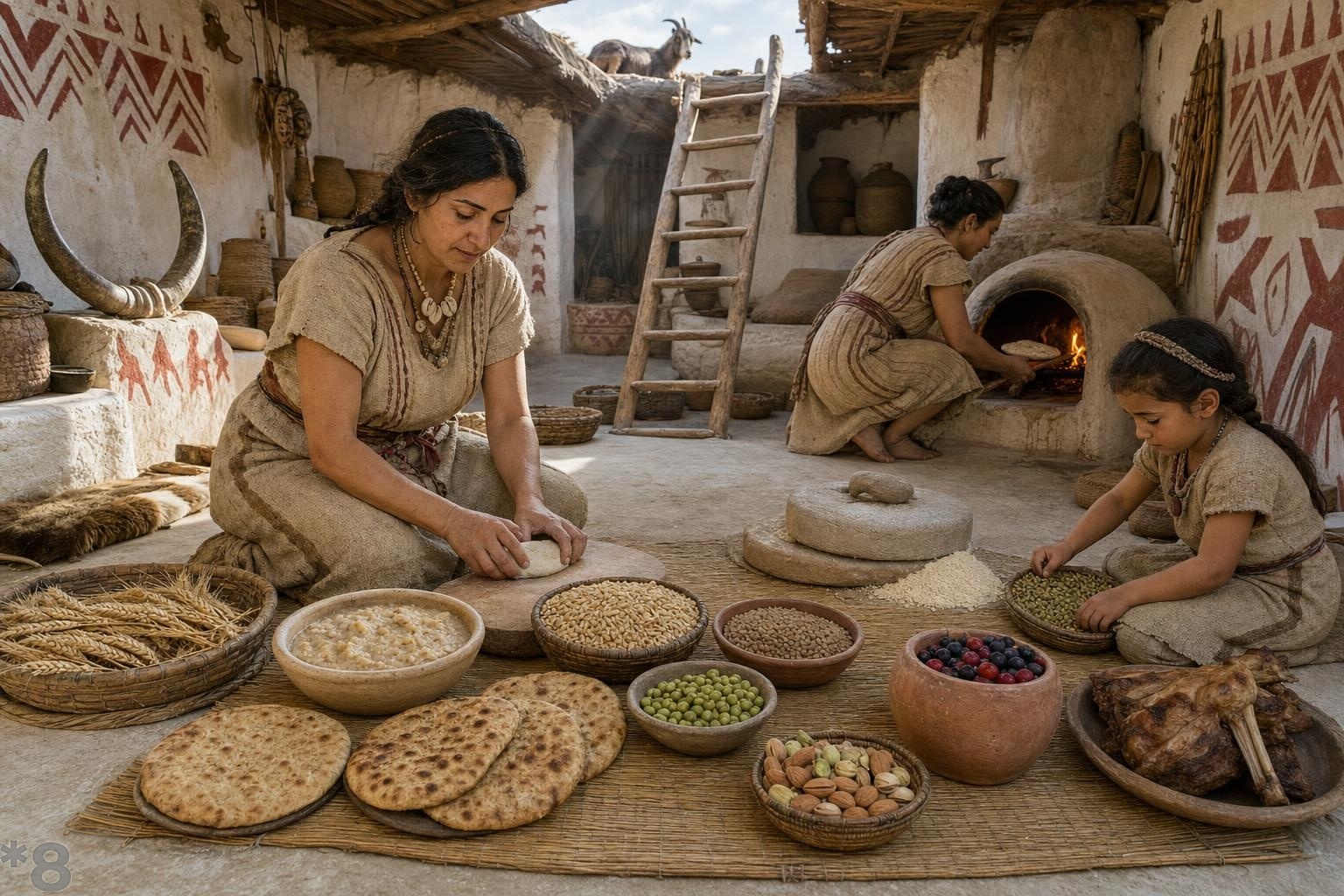
Shubayqa’s bread-like classification likewise depends on the researchers’ microscopic analysis of carbonized food remains [1]. It is a reasoned identification, stronger than a hypothesis drawn solely from nearby tools, but not the equivalent of watching the food being made. “Bread-like” preserves that evidentiary limit. Porridge, gruel, dough, and flat baked products may share ingredients while differing in moisture, processing, and heat treatment. The archaeological record does not always preserve enough information to distinguish every possibility confidently.
This is also why the absence of bread fragments from an older site does not prove that no bread was made there. Organic foods decay; fires consume; excavations sample only part of a settlement; and old collections were not necessarily recovered or examined with modern residue methods. The strongest defensible formulation is that Shubayqa provides the earliest currently identified direct evidence discussed here, not that its inhabitants were certainly the first bakers in human history.
What the first bread was not
The Shubayqa fragments challenge three familiar assumptions. First, bread did not have to wait for agriculture: the direct evidence predates established farming by thousands of years [1]. Second, early bread-like food need not have been a wheat-only product. The likely ingredients include wild einkorn and club-rush tubers, making it misleading to project a modern wheat-flour loaf backward onto the find [1]. Third, bread’s early appearance does not demonstrate that it was a staple. Its later importance belongs to a separate history of cereal cultivation, domestication, and food supply.
Nor should these fragments be described as risen loaves. The study interprets them as probably flat, unleavened bread-like products [1]. Their existence cannot establish when intentional leavening began. More generally, “the first bread” is a convenient title for a research question, not the name of a single archaeologically observed invention. It compresses a long sequence of plant exploitation, processing technology, cooking, and changes in subsistence into one familiar food.
The most compelling conclusion is therefore modest but substantial. People used grass seeds at least 105,000 years ago; some Upper Paleolithic groups ground wild plants tens of thousands of years later; Ohalo II offers evidence for cereal grinding and a plausible baking context; and Shubayqa preserves a bread-like product itself [7, 4, 3, 2, 1]. These are not identical discoveries and should not be ranked as if they were. Together they show that the prehistory of bread begins well before agriculture, while the history of bread as a routine food is closely tied to farming.
What remains uncertain
The date of the first bread-making event is unknown. Earlier processing tools establish technological possibilities but do not demonstrate baked food. At Ohalo II, the proposed dough baking rests on contextual inference. At Shubayqa, the food survives, but its exact preparation sequence, frequency of consumption, and social purpose cannot be reconstructed securely. The transition from occasional bread-like foods to staple bread was uneven and is not directly dated by a single find. The Çatalhöyük comparisons support probable identifications of cereal meals, but do not identify every fragment confidently [9].
| Claim | What supports it | Label | Sources |
|---|---|---|---|
| Grass seeds, sorghum among them, were used in Mozambique from at least 105,000 years ago. | Grass-seed starch on Middle Stone Age tools from deposits spanning 105,000–42,000 years ago. No flour or bread is demonstrated. | Moderate | 7 |
| Oats were processed in several steps at Grotta Paglicci about 32,600 cal BP. | Oat starch on a pestle-grinder; heating before grinding is possible. No bread fragment. | Probable | 4 |
| Wild plants were ground into flour at Bilancino II, Kostenki 16-Uglyanka and Pavlov VI about 30,000 years ago. | Wild-plant starch on grinding tools; flour production is interpreted from the residues and tool wear. No bread survives. | Probable | 3 |
| Wild cereals were a staple plant food at Ohalo II about 23,000 years ago, and were ground on stone. | More than 90,000 plant remains; barley and possibly wheat starch on a ground stone. | Strong | 2, 5 |
| Dough may have been baked at Ohalo II. | An oven-like hearth near the grinding stone; baking is the excavators’ inference. | Interpretive | 2 |
| People at Ohalo II may have tried small-scale cultivation. | Thirteen proto-weed species among about 150,000 plant specimens; cultivation is the authors’ interpretation. | Interpretive | 6 |
| Bread-like products, probably flat and unleavened, were made at Shubayqa 1 about 14,400 years ago, before agriculture. | 24 charred fragments classified as bread-like by microscopy, probably made with wild einkorn and club-rush tubers. Frequency, recipe and setting are uncertain. | Strong | 1 |
| Domesticated-type cereals appear in significant proportions in southern Syria about 10.7–10.2 ka cal BP, after wild cereals were cultivated. | Domesticated-type chaff; earlier wild-cereal cultivation in the southern-central Levant and Upper Euphrates; strong regional differences. | Strong | 8 |
Sources
- Arranz-Otaegui, A., González Carretero, L., Ramsey, M. N., Fuller, D. Q., & Richter, T. (2018). “Archaeobotanical evidence reveals the origins of bread 14,400 years ago in northeastern Jordan.” PNAS 115, 7925–7930. DOI: https://doi.org/10.1073/pnas.1801071115
- Piperno, D. R., Weiss, E., Holst, I., & Nadel, D. (2004). “Processing of wild cereal grains in the Upper Palaeolithic revealed by starch grain analysis.” Nature 430, 670–673. DOI: https://doi.org/10.1038/nature02734
- Revedin, A., Aranguren, B., Becattini, R., et al. (2010). “Thirty thousand-year-old evidence of plant food processing.” PNAS 107, 18815–18819. DOI: https://doi.org/10.1073/pnas.1006993107
- Mariotti Lippi, M., Foggi, B., Aranguren, B., et al. (2015). “Multistep food plant processing at Grotta Paglicci (Southern Italy) around 32,600 cal B.P.” PNAS 112, 12075–12080. DOI: https://doi.org/10.1073/pnas.1505213112
- Weiss, E., Wetterstrom, W., Nadel, D., & Bar-Yosef, O. (2004). “The broad spectrum revisited: evidence from plant remains.” PNAS 101, 9551–9555. DOI: https://doi.org/10.1073/pnas.0402362101
- Snir, A., Nadel, D., Groman-Yaroslavski, I., et al. (2015). “The origin of cultivation and proto-weeds, long before Neolithic farming.” PLoS ONE 10, e0131422. DOI: https://doi.org/10.1371/journal.pone.0131422
- Mercader, J. (2009). “Mozambican grass seed consumption during the Middle Stone Age.” Science 326, 1680–1683. DOI: https://doi.org/10.1126/science.1173966
- Arranz-Otaegui, A., Colledge, S., Zapata, L., et al. (2016). “Regional diversity on the timing for the initial appearance of cereal cultivation and domestication in southwest Asia.” PNAS 113, 14001–14006. DOI: https://doi.org/10.1073/pnas.1612797113
- González Carretero, L., Wollstonecroft, M., & Fuller, D. Q. (2017). “A methodological approach to the study of archaeological cereal meals: a case study at Çatalhöyük East (Turkey).” Vegetation History and Archaeobotany 26, 415–432. DOI: https://doi.org/10.1007/s00334-017-0602-6
In the atlas
Spot something wrong in this article?