
What Did Humans Eat 100,000 Years Ago?
Around 100,000 years ago, different hominin populations exploited combinations of terrestrial animals, marine resources, and plants. No reliable global meat-to-plant ratio can be calculated from surviving evidence.
A charred fragment is a rare witness
At Shanidar Cave in the Zagros Mountains, archaeologists recovered carbonized fragments of plant-based food from a Neanderthal occupation. Microscopic analysis identifies processed plant ingredients; it does not preserve a recipe, a portion size, or a representative daily meal [11]. The material is substantially younger than 100,000 years ago. That chronological distance matters, but so does the object itself: a fragile remnant of food survived where most cooked plants would have disappeared.
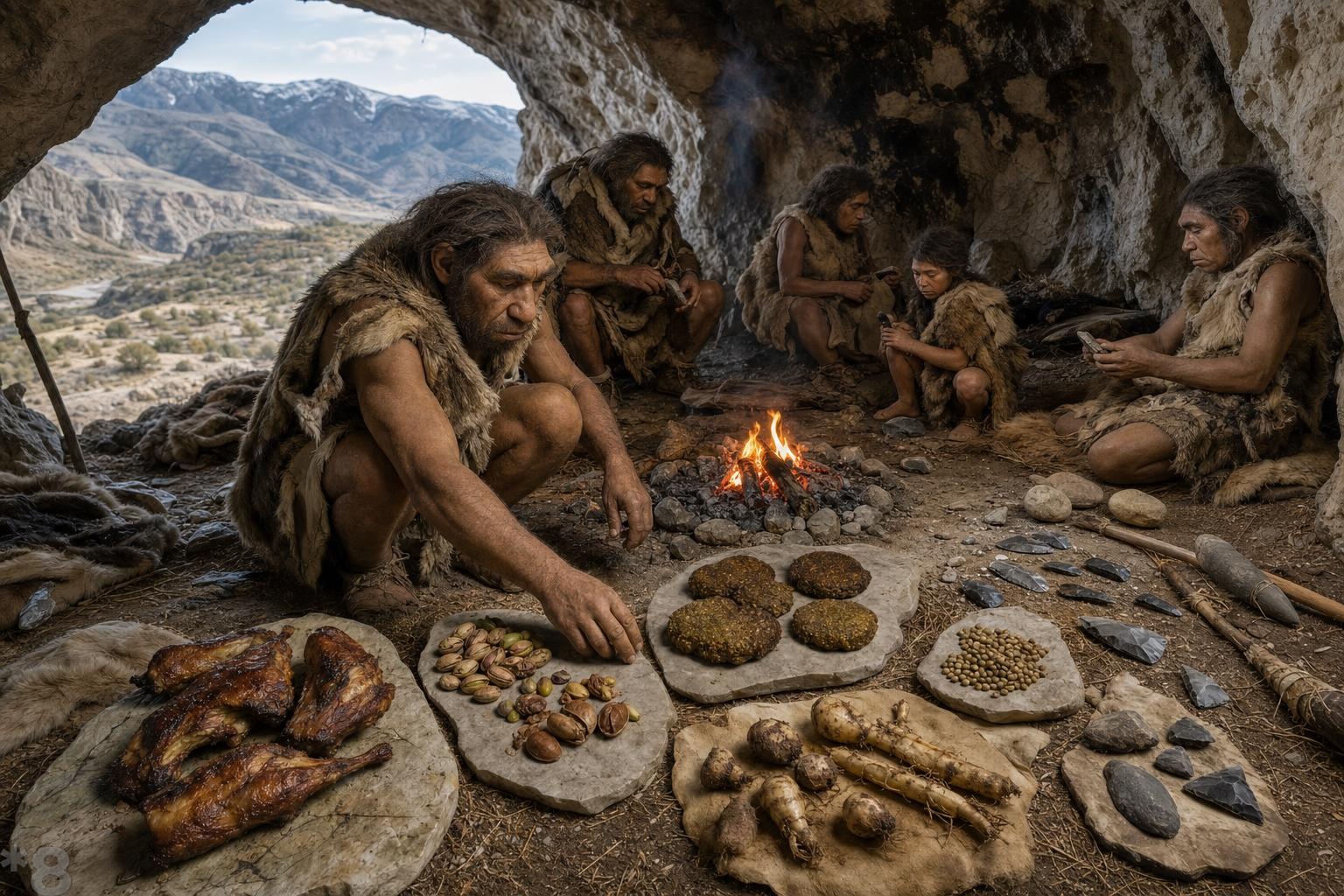
The better-known witnesses are more durable. Cut-marked bones preserve traces of carcass processing; shells survive where leaves and fruits decay; isotopes in bones reveal aspects of protein intake. These are powerful forms of evidence, but none is a census of calories. A comparison of diets around 100,000 years ago must therefore ask two questions at once: what was eaten, and what could archaeology recover?
There was no single population called “humans” with a single menu. Homo sapiens occupied Africa and parts of southwest Asia; Neanderthals lived in Europe and western Asia; other hominin populations inhabited eastern Eurasia. The six illustrated Atlas records linked below span coastal Africa, Gibraltar, the Levant, Siberia, and Flores. Their editorial date ranges overlap 100,000 BCE, but those ranges are not proof that every named discovery or species belongs to that precise moment.
A food trace is not a dietary percentage
Stone-tool cut marks on animal bones can demonstrate carcass processing when their morphology and archaeological context exclude plausible nonhuman causes. Percussion fractures may strengthen an inference of marrow extraction. Neither tells how often meat was eaten. Carnivores can accumulate bones; water and sediment movement can separate them from the activity that deposited them [4, 7].
Shell middens and marine fauna can establish that coastal resources were collected, although shell concentrations alone do not measure their contribution to annual nutrition. Microscopic charred plant tissues can identify cooking or heating; the survival of one fragment says little about how many unburned meals vanished [1, 2, 3]. Dental calculus sometimes traps starch grains and other plant microremains, offering a second route to otherwise invisible foods [5].
Stable carbon and nitrogen isotopes in preserved collagen are especially informative about dietary protein. They do not directly report the proportion of calories obtained from carbohydrate or fat. High trophic-level signatures can support substantial consumption of animal protein without establishing that plants were absent [6, 8]. Residue studies, flotation, fine sieving, and microbotanical analysis extend the range of detectable foods, but every method has sampling and contamination constraints.
The evidentiary hierarchy is consequently narrow: a demonstrably worked bone supports butchery; a reliably identified charred tuber tissue supports plant processing; reconstructing the balance of a year's meals requires much more than either object.
South African shores supplied food long before 100,000 years ago
At Pinnacle Point Coastal Foragers, deposits dated to approximately 164,000 years ago contain marine-resource evidence associated with early modern humans. The dated context supports exploitation of coastal foods; it cannot establish that shellfish were the principal source of energy, nor that every occupation in the cave sequence used the shore in the same way [3]. The site is older than the title's focal date, which makes it evidence for an established practice, not a direct snapshot of a meal at 100,000 years ago.
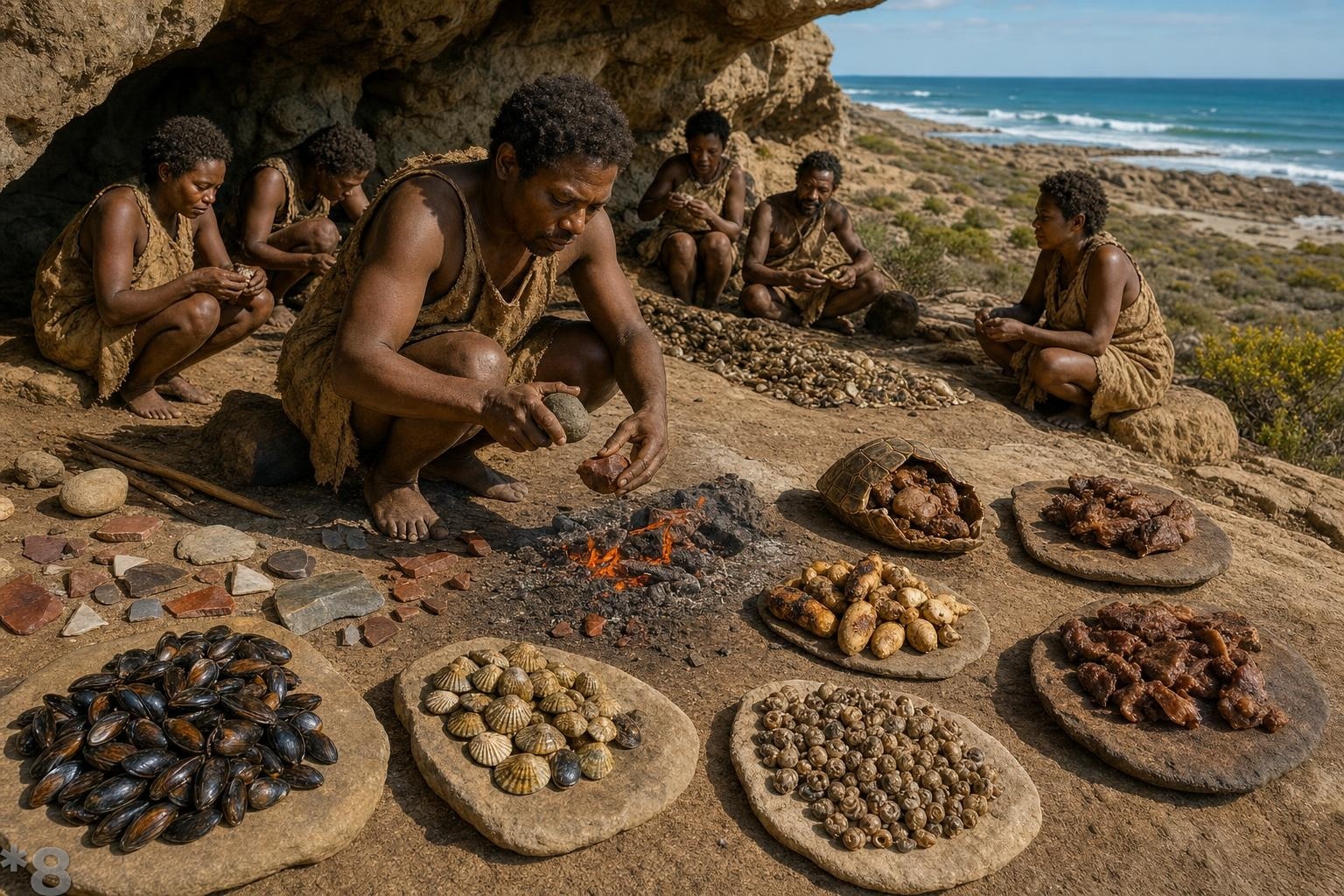
Blombos Cave Innovators adds a separate Middle Stone Age coastal sequence. Studied shell assemblages support shellfish collection in particular archaeological layers [2]. That evidence is more specific than the claim that all southern African people ate seafood. Shore access, seasonality, technology, and the shifting coastline would have shaped what was available. Blombos and Pinnacle Point are not interchangeable deposits, even when their illustrations evoke a similar landscape.
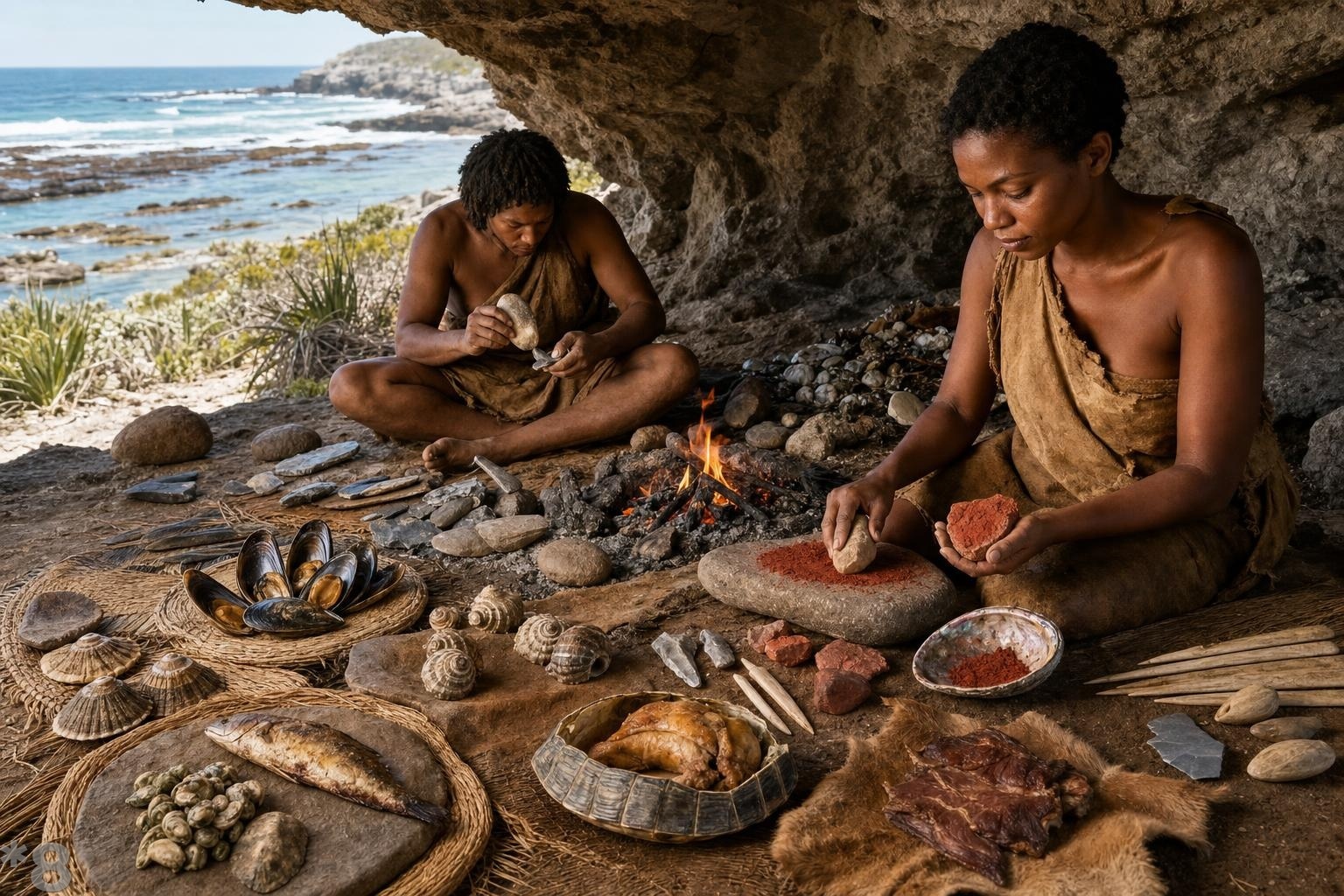
The strongest regional corrective comes from Klasies River, a different site. Charred plant tissues in hearths dated to approximately 120,000 and 65,000 years ago support the heating of starchy underground plant parts [1]. The microscopic evidence does not securely identify a universal recipe or a caloric fraction. It does show why a narrative assembled only from shells and animal bones would be incomplete. Coastal foods were consumed; at least some plant foods were also prepared. How frequently either appeared on the table remains beyond measurement.
Gibraltar complicates the image of the Neanderthal hunter
The Neanderthals of Gibraltar lived near marine environments unlike those of many inland European groups. Published reports of marine exploitation in Gibraltar's cave sequences support the limited proposition that some Neanderthals used coastal resources. The specific assemblages and their dates still need to be checked against the primary excavation reports before a particular seafood species or occupation age is asserted here.
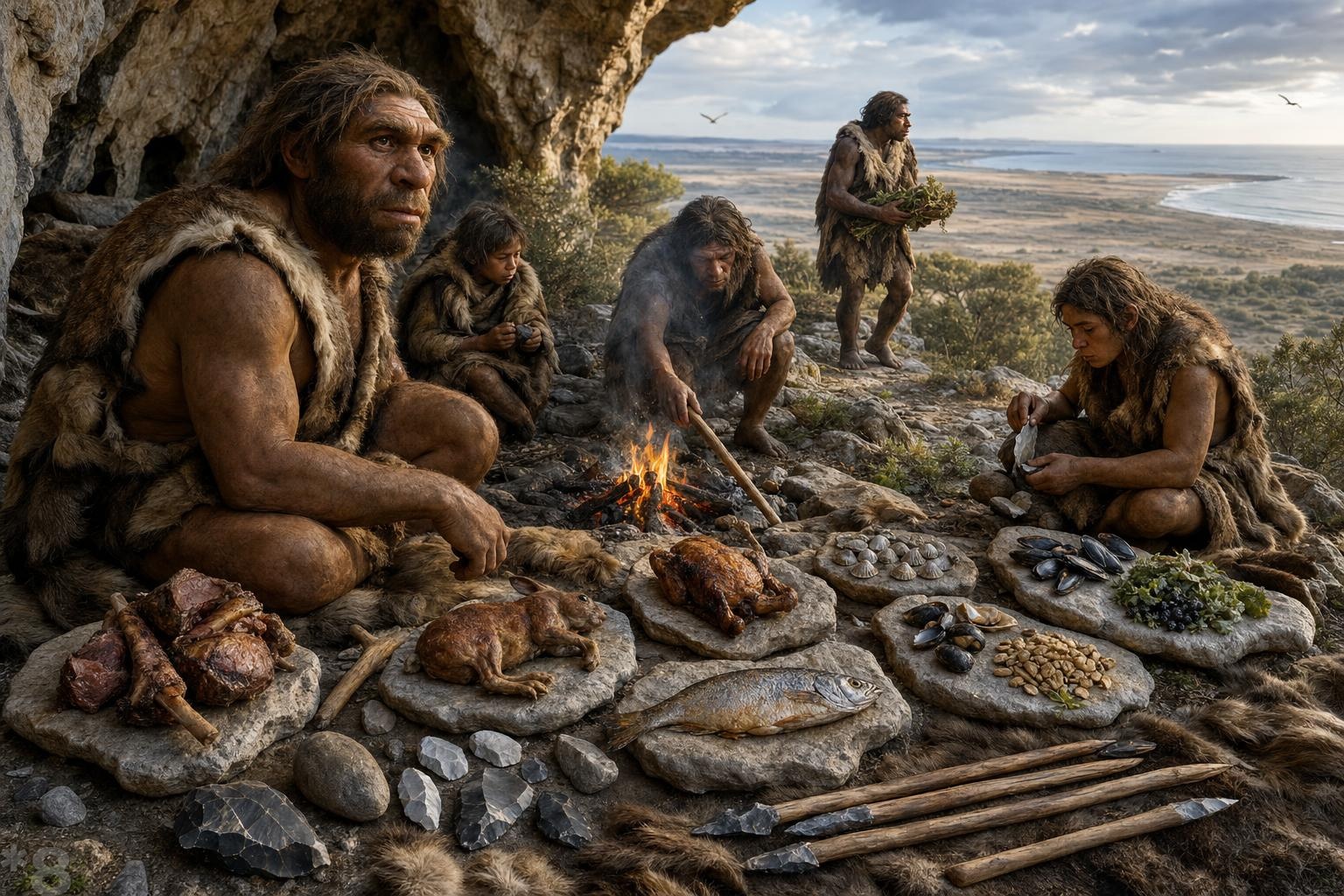
This is not a trivial qualification. A mollusk shell near a hearth, a seal bone, and a stable-isotope measurement from a different Neanderthal population answer different questions. European collagen isotope studies suggest that terrestrial animal protein was important for some Neanderthals [6, 8]. They do not cancel evidence for local marine foraging, and marine remains in Gibraltar do not show that seafood dominated the annual diet. Different landscapes could support different strategies.
A coastal Neanderthal diet is therefore defensible as a documented possibility in some contexts, not a standardized alternative to big-game hunting. The Gibraltar card belongs in this comparison because it tests a generalization against local evidence—not because it supplies an exact menu for 100,000 BCE.
The Levant preserves a long record, not one long meal
Tabun Cave’s Long Record spans major changes in occupation and environment in the Mount Carmel region. Its Atlas range of 350,000–45,000 BCE is an editorial summary of a complex sequence. Material from distant layers cannot be combined as though it belonged to one community. Neither can the identity of every occupant be inferred from the cave's name.
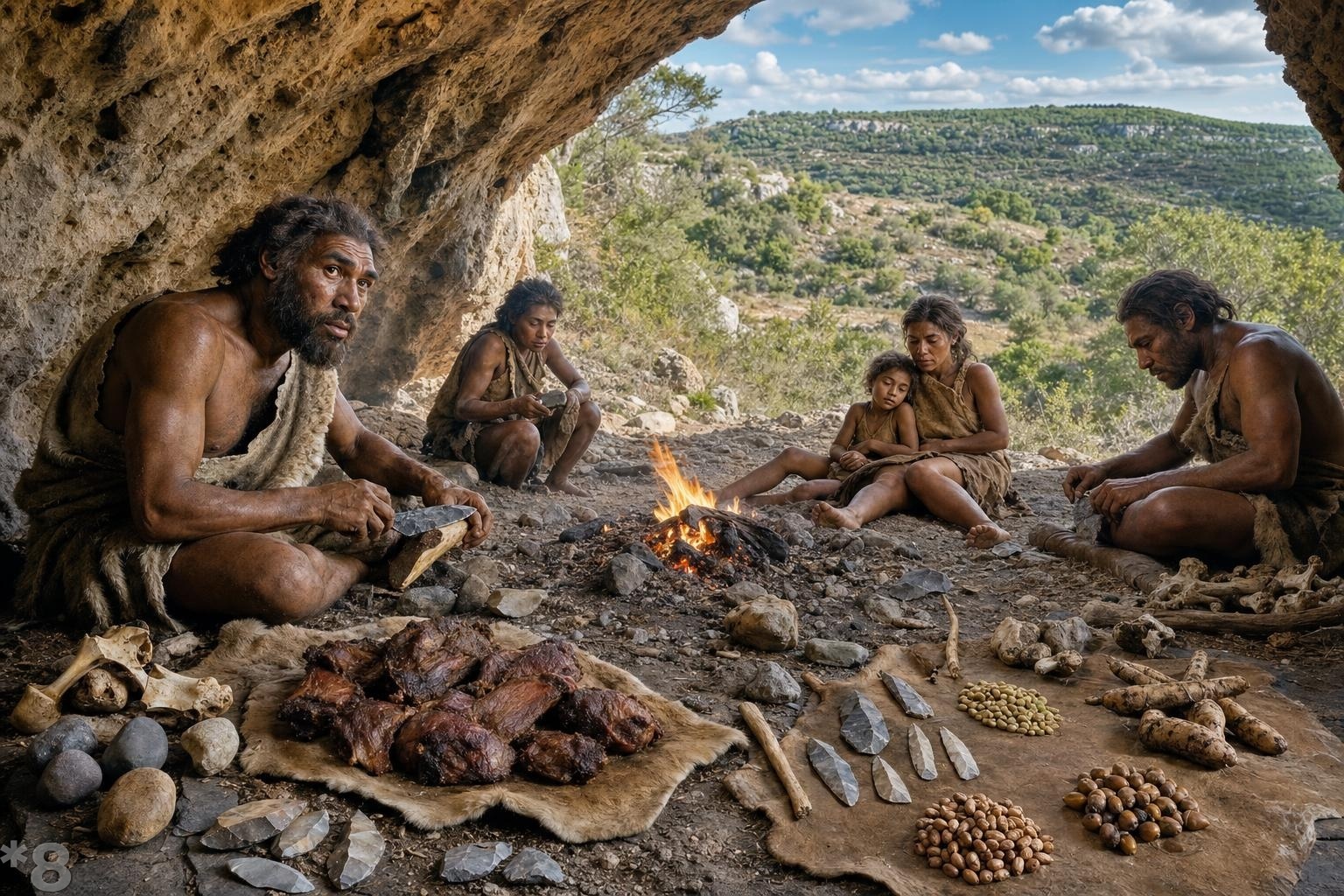
Nearby Misliya Cave offers a useful, older comparator. Analyses of its faunal remains identify ungulate carcass processing, supported by cut marks, breakage patterns, and taphonomic study [4, 7]. These finds are not from Tabun, and they predate the article's focal interval. Their value is methodological: animal remains can reveal particular acts of obtaining and processing food even when they cannot establish a full diet.
For Tabun itself, this draft does not claim a quantified balance between hunted mammals and gathered plants. Plant preservation and differences in recovery methods make such a balance especially uncertain. The defensible regional statement is that terrestrial animal exploitation formed part of some Levantine Middle Paleolithic economies; the size and composition of plant intake at a particular Tabun horizon require layer-specific evidence.
Flores shows why association must be demonstrated
On the Indonesian island of Flores, Homo floresiensis at Liang Bua introduces a hominin lineage in an insular ecosystem. Fossils, stone artifacts, and animal remains make the cave archaeologically important, but their presence within a long sequence does not prove that a given individual made a given tool or ate a given animal.
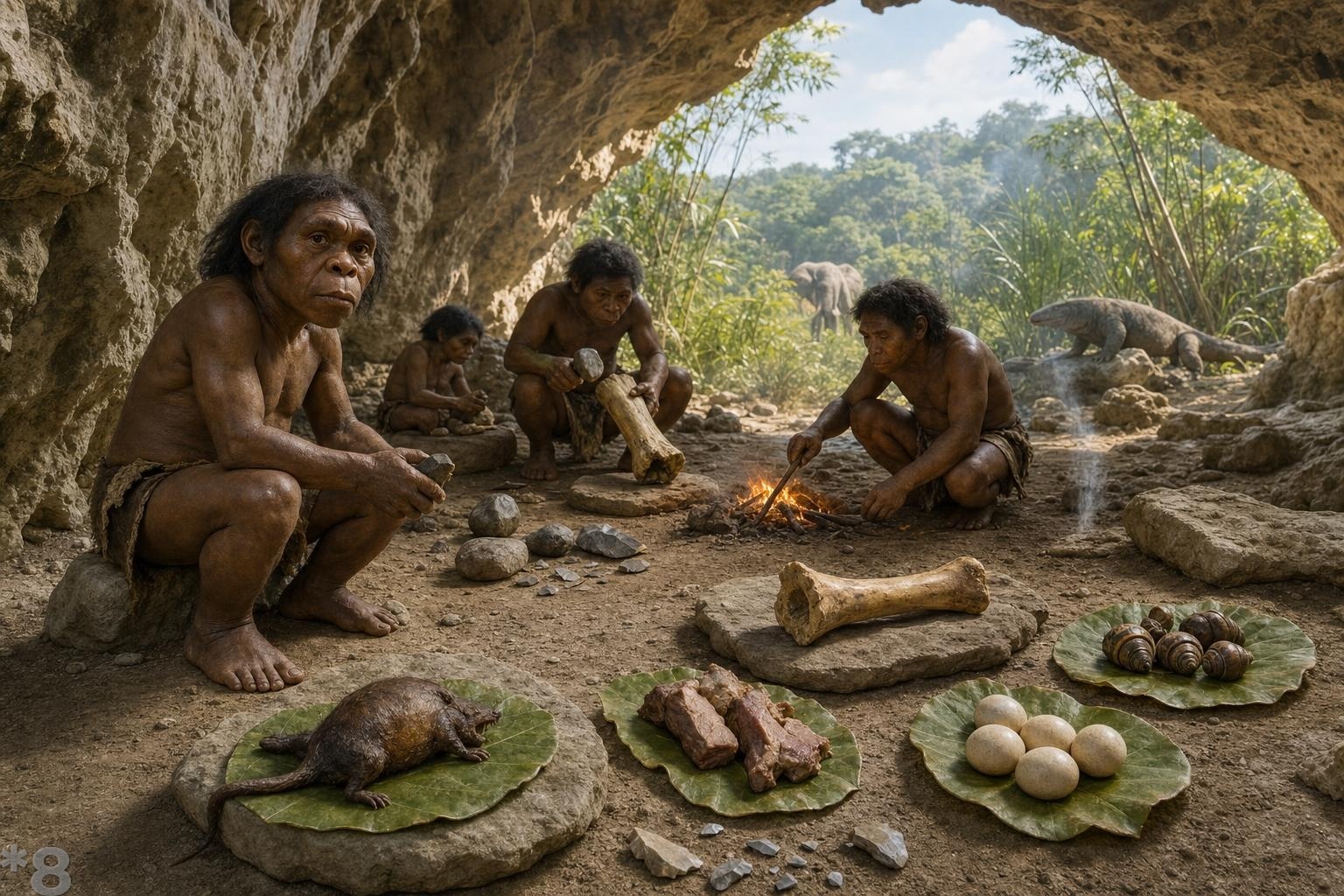
The Atlas records 100,000–50,000 BCE. Revised dating of H. floresiensis skeletal remains and archaeological contexts requires distinguishing fossil ages from artifact ages rather than treating that interval as a single occupation event. Before identifying particular prey or cooking practices, the relevant faunal and stratigraphic publications must establish secure association and modification. Environmental availability is a hypothesis about potential foods, not proof of consumption.
The Flores case thus adds a different kind of result to the comparison: the evidence establishes a human presence in a distinctive environment more securely than it establishes a detailed dietary inventory at 100,000 years ago. A responsible food history should make that asymmetry visible.
Denisova warns against assigning a cave's bones to its most famous occupants
Denisova Cave Populations extends the geographical comparison to Siberia. The Atlas's 200,000–45,000 BCE range encompasses a long, complicated record involving more than one hominin population. A cave can accumulate animal bones through human activity, carnivore visits, natural deaths, and sedimentary movement. Co-occurrence in the same cave is not enough to identify a Denisovan meal.
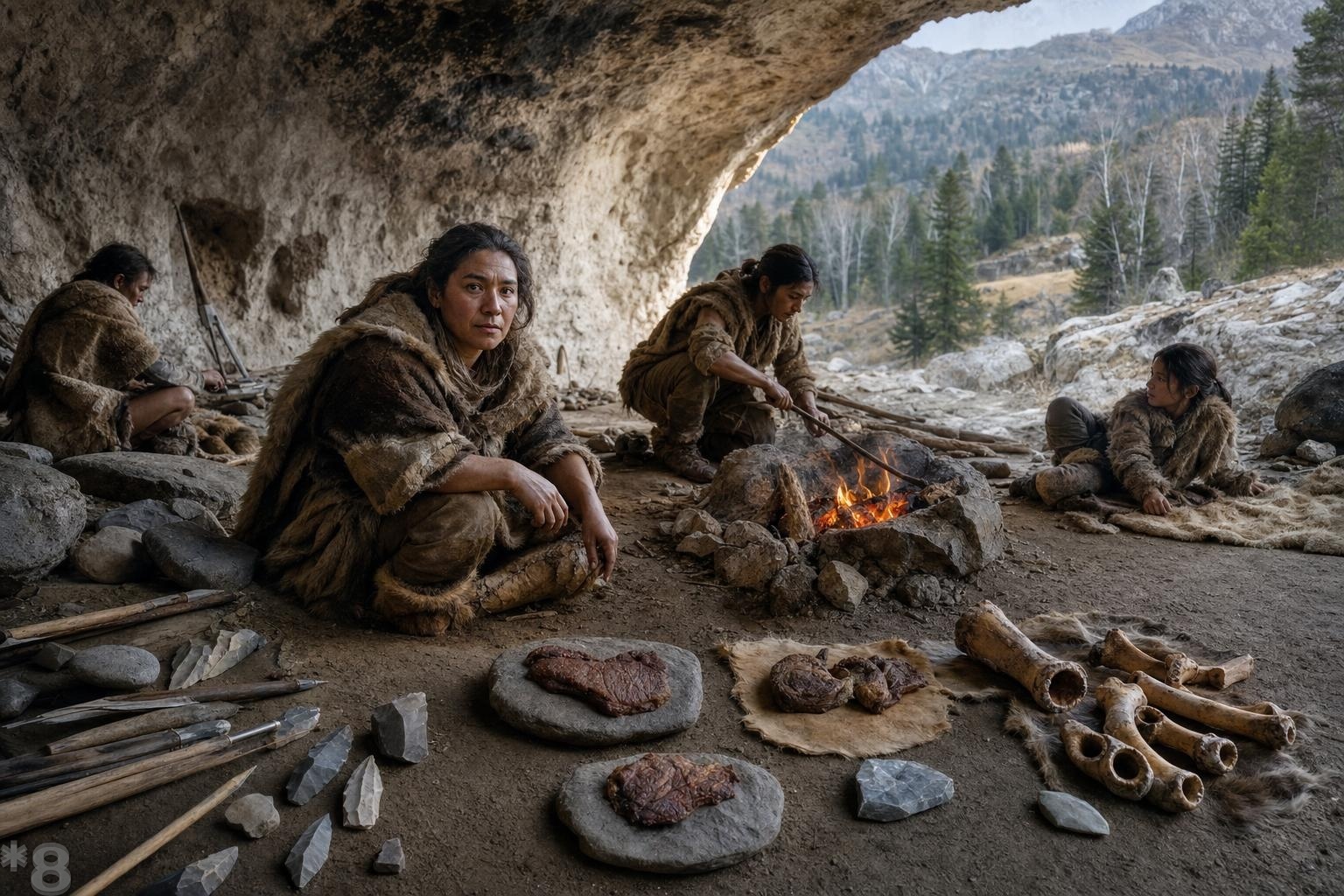
The question here is not whether Siberian inhabitants could have exploited particular animals. It is whether dated, modified remains can be attributed to a specific occupation and, still more demanding, to a particular lineage. Without that chain of evidence, naming a Denisovan prey list would convert ecological plausibility into historical assertion.
Denisova is included not as an empty entry but as a control on the argument: confidence in a hominin's presence does not transfer automatically to confidence in its diet.
Plant foods appear when the methods are capable of finding them
The charred food from Shanidar is a rare direct witness to plant processing, although its age is not 100,000 years [11]. Separate research on dental calculus from Shanidar and Spy found microfossils consistent with plant consumption and, in some cases, heating [5]. These are different specimens, methods, and chronological contexts; they should not be folded into one reconstructed dinner.
El Sidrón offers another methodological comparison. Dental calculus can preserve material that would otherwise decay, but particular dietary identifications from this Spanish site should be checked against its primary analytical studies before specific plants are named. Such signals can be sensitive to contamination, identification methods, and the difference between material entering the mouth and a substantial food source.
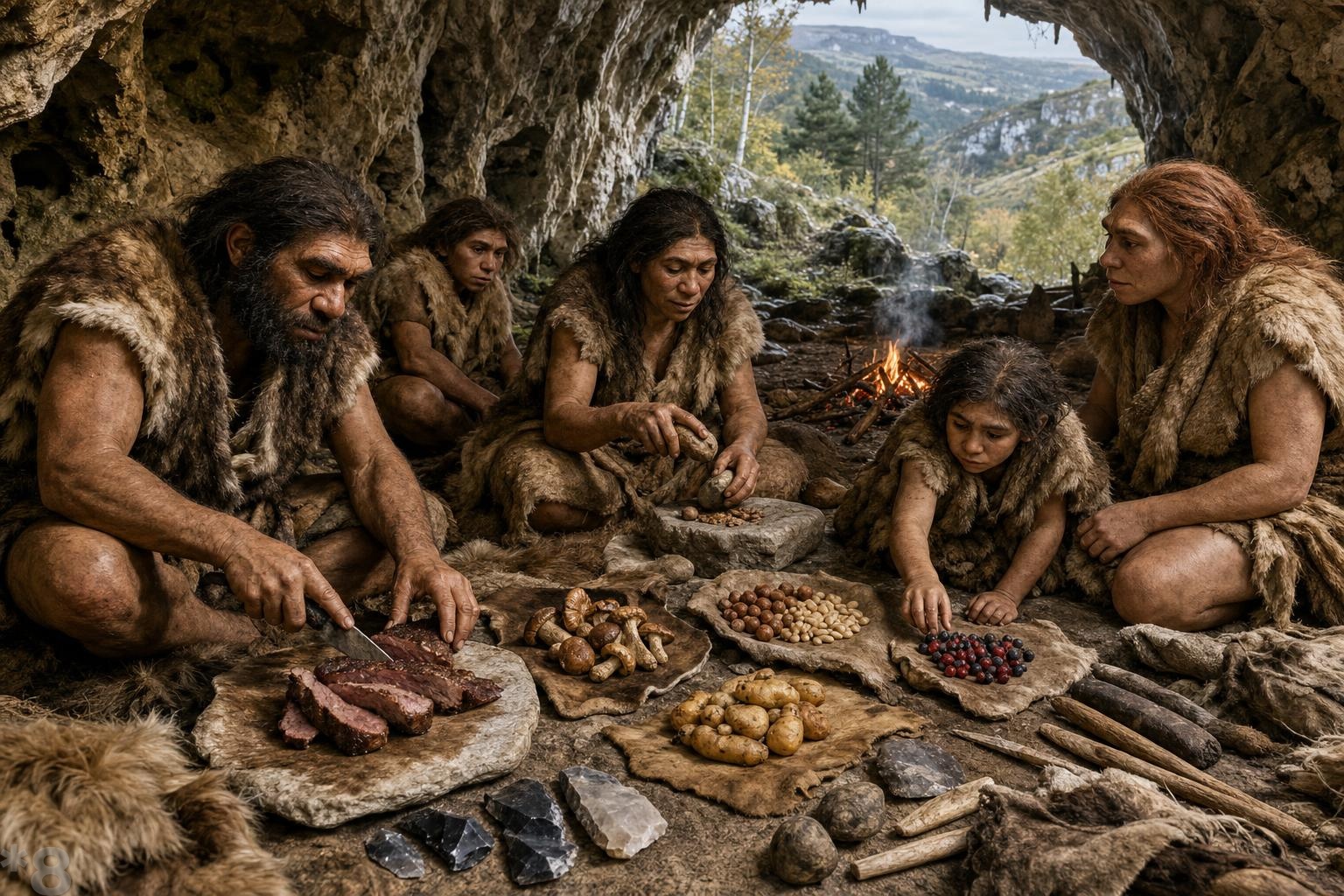
Together, these cases make a limited but consequential point: plant foods are not necessarily absent from a deposit simply because its visible artifacts are bones and stone tools. Specialized analysis can change the documented menu without changing what was actually eaten.
The archaeological record favors what survives and what researchers collect
Bone and shell are often more durable than fruit, leaves, and many underground plant tissues. Burning can preserve a plant fragment as charcoal, but most food is not charred. Acidic soils may destroy bone; fragile fish remains may disappear through excavation without fine screens. The bias is strong, not universal, and it differs among sites.
Excavation adds a second filter. Caves are visible and often preserve layered deposits, whereas open-air activity areas can erode or escape discovery. Coastlines used during lower sea levels may now lie underwater. Recovery procedures matter: flotation can reveal seeds, and microscopy can identify tissues invisible to ordinary sorting. Earlier excavations did not always collect samples suited to these methods.
Research questions add a third filter. Assemblages historically described through large bones and stone tools may yield a broader food history when dental calculus, charred plant tissues, and residues are studied. Yet a single starch grain cannot establish a plant-rich diet, just as a heap of butchered bones cannot establish a meat-only diet. Frequency, portions, and seasonality remain separate questions.
Finally, attribution itself is biased toward memorable names. Tabun and Denisova contain complex histories; Liang Bua joins fossils and artifacts across different contexts. An animal bone should not be assigned to the best-known occupant without a demonstrated chronological and behavioral link. The archaeological record is not merely incomplete: it has been filtered by decay, landscape change, excavation choices, and the questions scholars ask.
The strongest answer is diversity, with important blanks
Around 100,000 years ago, some populations exploited hunted terrestrial animals, and some coastal populations gathered marine foods. Archaeology also establishes plant processing in relevant Middle and Late Pleistocene contexts, though the best examples are not always exactly contemporaneous with the target date [1, 2, 3, 4, 5, 11]. Isotopes can suggest reliance on animal protein in particular Neanderthal groups, but not a universal proportion of meat-derived calories [6, 8].
There was no single diet waiting to be recovered. There were local diets, changing through time. The evidence is clearest about certain acts—collecting shellfish, cutting carcasses, heating plants—and weakest where modern claims are often most confident: the percentage of prehistoric meals made of meat.
What remains uncertain
What remains unknown is substantial: typical serving sizes, the share of calories from plants, seasonal substitutions, individual variation, and many species-level identifications. Even the six Atlas cards are not six synchronized samples. They are differently preserved windows onto different populations and landscapes.
Site-specific claims about Gibraltar's marine use, Liang Bua's prey, Denisovan menus and El Sidrón's plant identifications still need checking against primary site studies before they can be stated more strongly. The Atlas card date ranges alone do not verify diet.
| Claim | What supports it | Label | Sources |
|---|---|---|---|
| Marine resources were used at Pinnacle Point by ~164 ka. | Archaeological marine-resource remains and dated context; older than 100 ka. | Strong | 3 |
| Shellfish were exploited in Middle Stone Age Blombos contexts. | Shellfish assemblages and archaeological analysis; layer dates matter. | Strong | 2 |
| Some southern African people cooked starchy underground plants. | Charred plant parenchyma at Klasies River, ~120 and 65 ka; the heated tissue is direct evidence, its preparation as food an inference. | Probable | 1 |
| Some European Neanderthals relied heavily on terrestrial animal protein. | Carbon/nitrogen isotopes in bone collagen, which measure protein, not calories. | Moderate | 6, 8 |
| Levantine humans processed ungulate carcasses in older Middle Paleolithic contexts. | Cut marks and fractures at Misliya, not Tabun; an older regional comparator. | Strong | 4, 7 |
| Some Neanderthals consumed or processed plant foods. | Shanidar/Spy calculus microfossils; later Shanidar charred-food analyses. Recipes and dating remain qualified. | Strong | 5, 11 |
Sources
- Larbey, C., et al. (2019). “Cooked starchy food in hearths ca. 120 kya and 65 kya (MIS 5e and MIS 4) from Klasies River Cave, South Africa.” Journal of Human Evolution. DOI: https://doi.org/10.1016/j.jhevol.2019.03.015
- “Middle Stone Age shellfish exploitation: Potential indications for mass collecting and resource intensification at Blombos Cave and Klasies River, South Africa.” (2012). Quaternary International. Publisher record: https://www.sciencedirect.com/science/article/abs/pii/S1040618211005131 (complete bibliographic details pending verification).
- Marean, C. W., et al. (2007). “Early human use of marine resources and pigment in South Africa during the Middle Pleistocene.” Nature 449, 905–908. DOI: https://doi.org/10.1038/nature06204
- Yeshurun, R., Bar-Oz, G., & Weinstein-Evron, M. (2007). “Modern hunting behavior in the early Middle Paleolithic: Faunal remains from Misliya Cave, Mount Carmel, Israel.” Journal of Human Evolution. DOI: https://doi.org/10.1016/j.jhevol.2007.05.008
- Henry, A. G., Brooks, A. S., & Piperno, D. R. (2011). “Microfossils in calculus demonstrate consumption of plants and cooked foods in Neanderthal diets (Shanidar III, Iraq; Spy I and II, Belgium).” PNAS. Full text: https://pmc.ncbi.nlm.nih.gov/articles/PMC3021051/
- Richards, M. P., & Trinkaus, E. (2009). “Isotopic evidence for the diets of European Neanderthals and early modern humans.” PNAS 106, 16034–16039. DOI: https://doi.org/10.1073/pnas.0903821106
- Yeshurun, R., et al. (2020). “Site occupation dynamics of early modern humans at Misliya Cave (Mount Carmel, Israel): Evidence from the spatial taphonomy of faunal remains.” Journal of Human Evolution. Publisher record: https://www.sciencedirect.com/science/article/abs/pii/S0047248420300580
- Richards, M. P., et al. (2000). “Neanderthal diet at Vindija and Neanderthal predation: The evidence from stable isotopes.” PNAS. DOI: https://doi.org/10.1073/pnas.120178997
- “Dental calculus reveals potential respiratory irritants and ingestion of essential plant-based nutrients at Lower Palaeolithic Qesem Cave Israel.” (2016). Quaternary International. Publisher record: https://www.sciencedirect.com/science/article/abs/pii/S1040618215004553 (background method reference; metadata pending).
- Yellen, J. E., et al. (1995). “A Middle Stone Age worked bone industry from Katanda, Upper Semliki Valley, Zaire.” Science. DOI: https://doi.org/10.1126/science.7725100 (background regional comparison; not used to attribute foods to the six featured sites).
- Kabukcu, C., et al. (2023). “Cooking in caves: Palaeolithic carbonised plant food remains from Franchthi and Shanidar.” Antiquity 97, 12–28. DOI: https://doi.org/10.15184/aqy.2022.143
In the atlas
Spot something wrong in this article?