
The First Farmers: How Agriculture Changed Human Diets
Farming was invented independently in several parts of the world, and in each the new crops took thousands of years to become what people mainly ate. When they did, diets narrowed to a few starchy staples, more children were born, and skeletons record more tooth decay, more disease and shorter adults.
Not one beginning but several
Farming was not invented once and then carried around the world. Plants and animals were brought under human control independently in several regions, among them Southwest Asia, northern and southern China, Mexico, South America, the New Guinea highlands and eastern North America [1]. Each region started with different plants, on its own schedule. Setting them side by side shows which changes to the human diet came with farming everywhere, and which belonged to one place.
Four kinds of evidence carry the comparison. Charred seeds and microscopic plant remains show which plants people used, and changes in their shape show when those plants became domesticated. Animal bones show when herds were managed rather than hunted. The chemistry of human bone shows what people ate over years of their lives. Skeletons and teeth show what the new diet did to the people who ate it. The four rarely change at the same moment, and the gaps between them are the main finding of this investigation.
Southwest Asia: cultivation long before domestic crops
The first step was a new habit, not a new plant. At Ohalo II, a camp on the shore of the Sea of Galilee about 23,000 years ago, people gathered more than 140 plant species and ground wild wheat and barley. Mixed with the wild cereal seeds were 13 species that are weeds of cultivated fields today, which the excavators read as the earliest small-scale attempt to cultivate wild cereals, some 11 millennia before farming [2]. It is one site and one interpretation, but it shows that tending wild cereals could begin long before anything looked like a farm. Our investigation The First Bread: Before Agriculture follows what foragers in the region made from such grains.
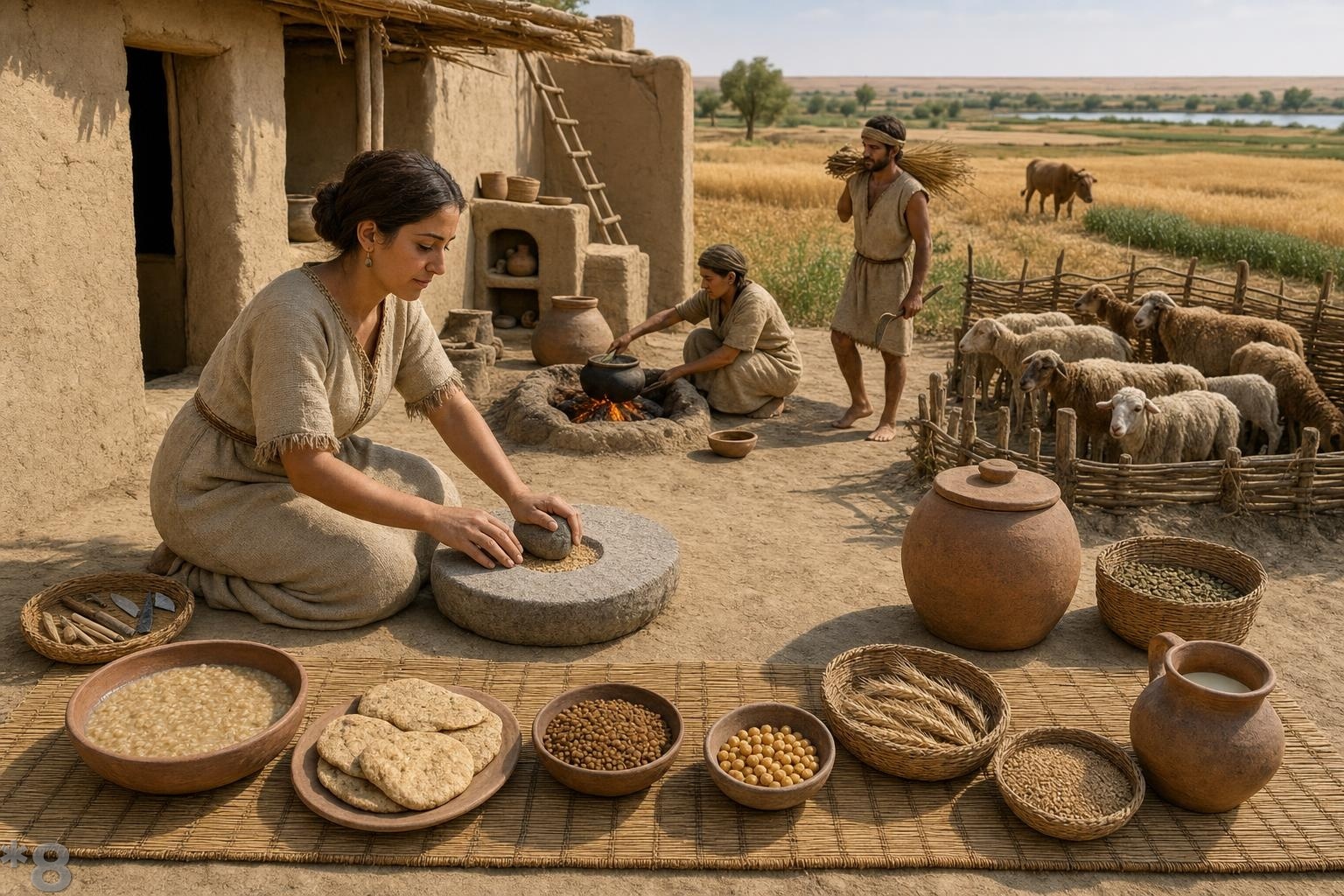
Wild cereals scatter their seeds when they ripen; domesticated cereals hold them until they are harvested. That change from shattering to non-shattering ears is the clearest sign of domestication, and in Southwest Asia it was slow. Ken-ichi Tanno and George Willcox found that non-shattering wheat appears only about 9,500 years ago, and that the wild, shattering kind was still common in cultivated fields about 7,500 years ago [3]. At Chogha Golan, in the foothills of the Zagros Mountains of Iran, people cultivated wild barley, wild lentils and peas over some 2,200 years, and domestic-type emmer wheat appears there only around 9,800 years ago [4]. Melinda Zeder’s review of the region describes the change as spread across the whole Fertile Crescent and drawn out over millennia, not a single invention in a single place [5].
Animals followed a similar path. Goat bones from the Zagros about 10,000 years ago show a shift to culling mostly young males, the mark of people managing herds rather than hunting wild goats [6]. On the plant evidence, it took thousands of years more before domestic forms had replaced wild ones in the fields [3].
China: millet in the north, rice in the south
China had two farming traditions, built on different plants, and neither began with a domesticated crop. In the north, starch grains on grinding stones and on an early pottery sherd from Nanzhuangtou and Donghulin show millet in use between about 11,500 and 9,500 years ago. The pattern of the starch led Xiaoyan Yang and colleagues to suggest that foxtail millet was cultivated for some two thousand years while it was becoming domesticated [7]. At Cishan, storage pits held husk remains identified as broomcorn millet, in contexts the excavators date to between about 10,300 and 8,700 years ago [8].
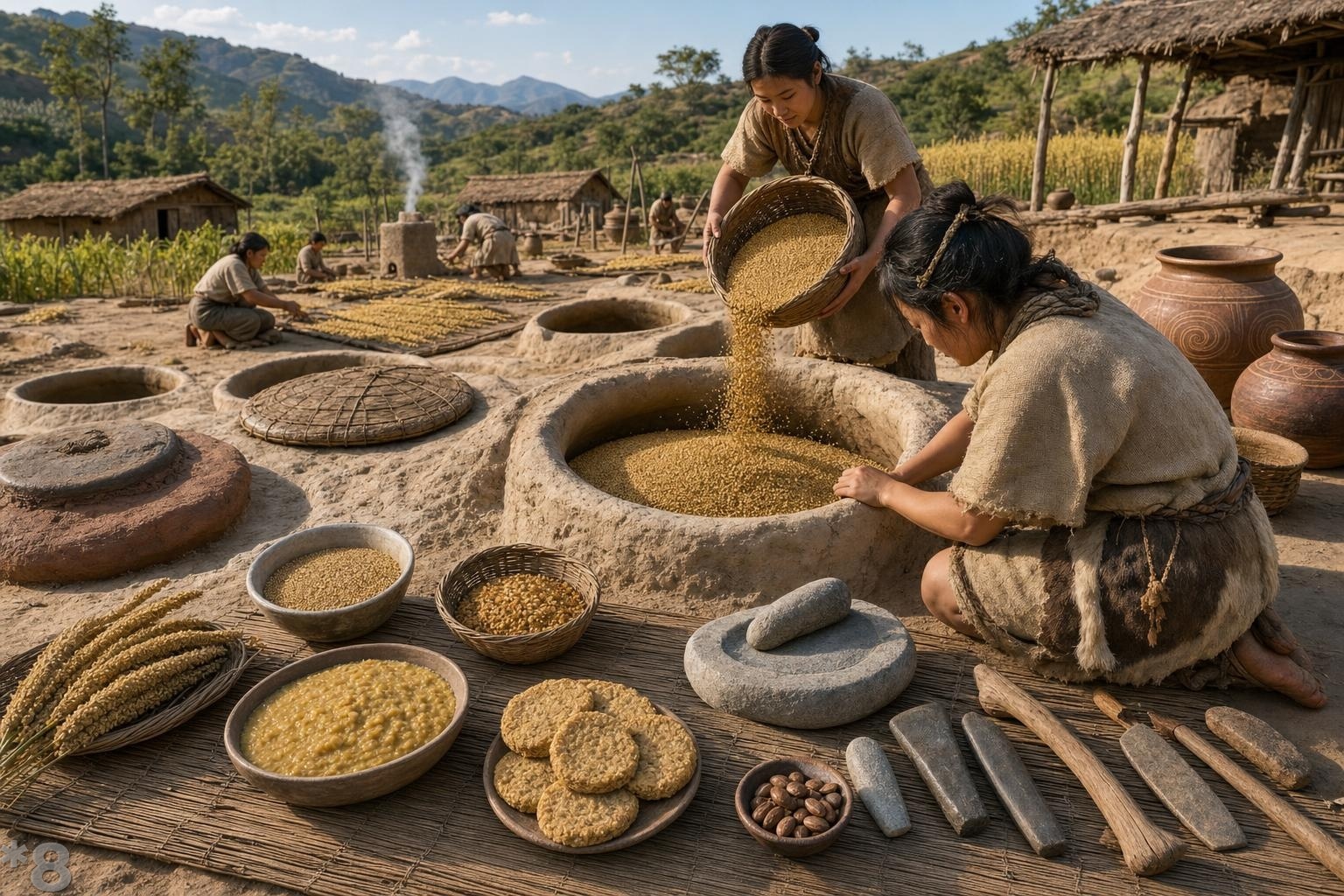
Bone chemistry shows how long millet took to become the main food. At Dadiwan in northwest China, people at various times between about 7,900 and 7,200 years ago harvested and stored enough broomcorn millet to feed themselves and their hunting dogs through the year, but this early phase was brief and small in scale. Only by about 5,900 years ago did broomcorn and foxtail millet make a significant part of the diet of people, dogs and pigs [9].
In the Lower Yangtze, the change can be measured at a single village. At Tianluoshan, between about 6,900 and 6,600 years ago, the share of rice spikelet bases of the non-shattering, domesticated type rose from 27 to 39 per cent. Over the same three centuries, rice rose from 8 to 24 per cent of all plant remains, a sign that people were eating more of it relative to wild foods [10]. Even at the end of that period, three quarters of the plant remains were something other than rice.
The Americas: crops that took millennia to matter
In Mexico, the first domesticated plant on record is not maize but squash. Seeds and rinds from Guilá Naquitz, a cave in Oaxaca, show that Cucurbita pepo was domesticated about 10,000 years ago [11].
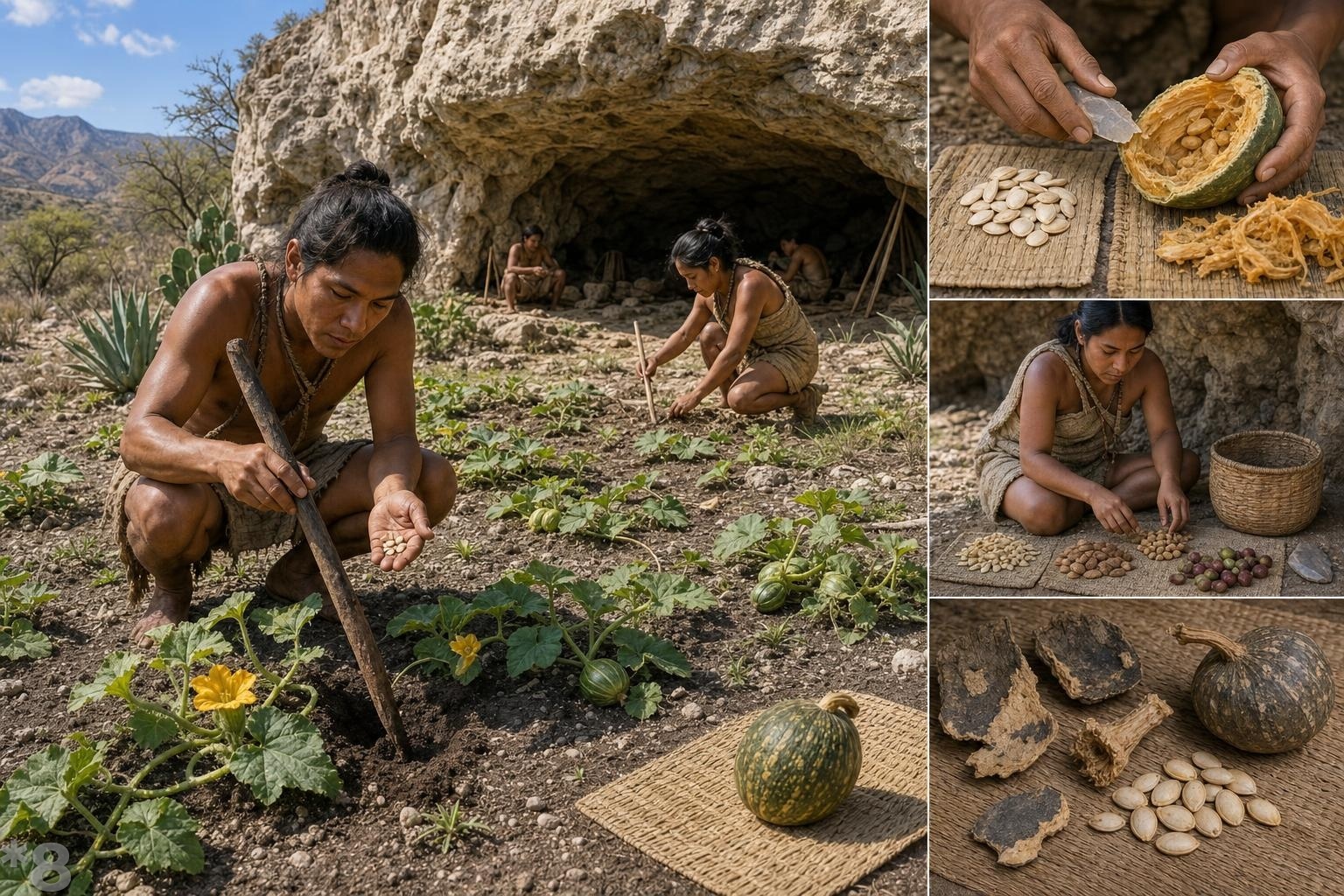
Maize was domesticated from teosinte, a wild grass native to the Balsas River valley of southwestern Mexico. Starch grains and phytoliths from the Xihuatoxtla rock shelter in that valley show maize present by about 8,700 years ago [12]. Yet maize was not a main food for a long time afterwards. The bone chemistry of 52 radiocarbon-dated people from two rock shelters in the Maya Mountains of Belize shows no clear sign of maize before about 4,700 years ago. Between 4,700 and 4,000 years ago, maize made up about 30 per cent of the diet of some individuals; after 4,000 years ago it made up more than 70 per cent, as it did for later farmers in the region [13]. That is the earliest firm evidence of maize as a staple anywhere in the Americas, some four thousand years after the oldest maize.
South America had its own early crops. In the Llanos de Moxos of Bolivia, people cultivated manioc about 10,350 years ago and squash about 10,250 years ago, and began building what became some 4,700 artificial forest islands in a seasonally flooded savanna; maize reached the area about 6,850 years ago [14]. On the western slopes of the northern Peruvian Andes, peanut, squash and cotton, directly dated to between 9,240 and 5,500 radiocarbon years ago, come from households, garden plots and irrigation canals [15]. Far to the north, eastern North America domesticated its own squash, sunflower, marsh elder and chenopod, independently of Mexico [16].
New Guinea: farming without grain
In the highlands of New Guinea, farming grew around plants that are not raised from seed. At Kuk Swamp, people exploited plants, and did some cultivating, at the edge of the wetland between about 10,200 and 9,900 years ago. Planting mounds appear between about 6,950 and 6,440 years ago, and drained, ditched fields about 4,300–4,000 years ago. Taro was used in the early Holocene, and by the time of the mounds bananas were being cultivated intensively [17]. This was farming invented independently, and it was based on roots and fruit rather than cereals.
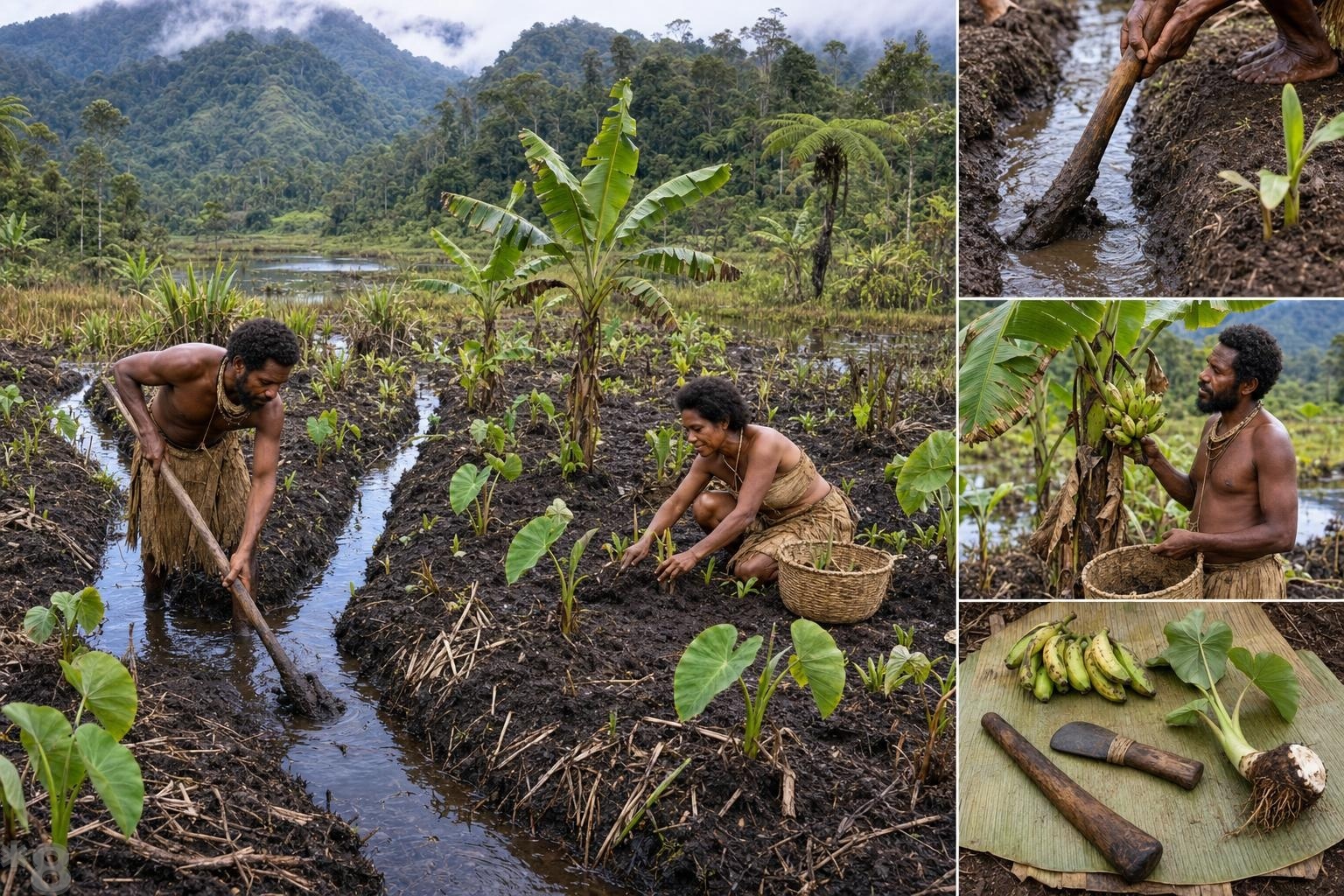
Roots and bananas rarely leave charred remains, so this kind of farming is much harder to see than cereal farming. At Kuk it was recognised through microscopic plant remains and the shape of the fields themselves.
What the new diet did to the people who ate it
When farming did take hold, it changed bodies in ways that can be measured. Clark Spencer Larsen’s review of skeletons from many parts of the world found that the move to farming was generally accompanied by more tooth decay, more signs of stress and infection, and reduced growth, though the pattern differed from region to region [18]. Amanda Mummert and colleagues revisited stature in studies published since 1984; most found adults growing shorter as reliance on agriculture increased, in Europe, Africa, the Middle East, Asia and the Americas [19].
Tooth decay is the clearest signal, because fermentable starch feeds the bacteria that cause it. But decay did not wait for farming. Hunter-gatherers at Grotte des Pigeons (Taforalt) in Morocco, who harvested acorns and pine nuts between about 15,000 and 13,700 years ago, had caries in 51.2 per cent of adult teeth, a rate comparable to modern industrialised populations [20]. What raised decay was a diet heavy in starchy food, not farming itself; farming made that diet the everyday one for far more people.
At Çatalhöyük in Anatolia, occupied between 7100 and 5950 BCE, the skeletons show what the change cost one large community. As it came to depend on domesticated plant carbohydrates, its members faced more disease and heavier workloads; its population grew larger and denser on higher fertility; and herding sheep and goats demanded more travel over the nearly twelve centuries of the settlement [21].

The same change shows in cemeteries across the world. Jean-Pierre Bocquet-Appel found an abrupt rise in the share of juvenile skeletons as societies turned to farming, which he reads as an increase in fertility of about two births per woman [22]. Farming fed more people. On the evidence of their skeletons, it did not feed them better.
Where farming arrived, the diet changed fast
Where farming was invented, the diet changed over thousands of years. Where it arrived ready-made, the change could be abrupt. In Britain, which received its cereals, sheep and goats from elsewhere, carbon isotopes in human bone show a sharp shift at the start of the Neolithic: marine foods, prominent in the diets of earlier coastal people, all but disappear, even among people living by the sea [23]. The contrast rests on a few well-studied cases, and whether it holds everywhere farming spread is a question this comparison cannot settle.
So how did agriculture change human diets?
Slowly where it began, and not in the same way everywhere. In each region where farming was invented, people cultivated wild plants for centuries or millennia before domesticated forms took over, and a domesticated crop could take thousands more years to become the main food [3, 9, 13]. The staples differed: wheat, barley and pulses with sheep and goats in Southwest Asia; millet, eaten by people, dogs and pigs alike, in northern China; rice in the Lower Yangtze; squash and then maize in Mexico; taro and bananas in New Guinea. The end point was similar. Diets came to rest on a few starchy staples, more children were born, and skeletons record more tooth decay, more disease and shorter adults [18, 19, 22]. Farming made it possible to feed far more people. It did not make the average person healthier.
What remains uncertain
Early cultivation leaves wild plants unchanged, so its first stages are hard to see, and cultivation in every region may have begun earlier than the dates given here. The Ohalo II case rests on one site and on reading weed seeds as a sign of cultivation. The earliest millet dates in northern China rest on a few sites and on microscopic remains, and need confirming by further finds. Root and fruit crops rarely preserve, so early farming in New Guinea, Amazonia and other tropical regions is likely underrepresented. The decline in health is an average with exceptions, and skeletons record the people who died, not the whole living population. The contrast between slow change where farming began and fast change where it arrived rests on a few cases. This comparison also leaves out Africa and South Asia, where farming had its own histories.
| Claim | What supports it | Label | Sources |
|---|---|---|---|
| Farming arose independently in several regions of the world. | Archaeological and genetic syntheses; independent centres documented in eastern North America and New Guinea. | Strong | 1, 16, 17 |
| In Southwest Asia, wild cereals were cultivated long before domestic forms took over. | Non-shattering wheat from about 9,500 years ago, wild forms still common about 7,500 years ago; 2,200 years of wild-plant cultivation at Chogha Golan. | Strong | 3, 4 |
| Wild cereals were cultivated on a small scale about 23,000 years ago at Ohalo II. | Thirteen weed species among wild cereal seeds at one site; cultivation is the excavators’ reading. | Limited | 2 |
| In northern China, millet was used from about 11,000 years ago but became a major food only by about 5,900 years ago. | Starch grains on grinding tools and a pottery sherd; millet husk remains in storage pits at Cishan; bone chemistry of people, dogs and pigs at Dadiwan. | Probable | 7, 8, 9 |
| Rice was being domesticated, and eaten more, in the Lower Yangtze 6,900–6,600 years ago. | Non-shattering spikelet bases rising from 27 to 39 per cent, and rice from 8 to 24 per cent of plant remains, at Tianluoshan. | Strong | 10 |
| Maize was present in Mexico by about 8,700 years ago but became a staple only after about 4,700–4,000 years ago. | Maize starch and phytoliths at Xihuatoxtla; bone chemistry of 52 dated people in Belize. | Strong | 12, 13 |
| The move to farming was generally followed by more births, more tooth decay, more disease and shorter adults. | Reviews of skeletal series from many regions, where the pattern varies; a detailed case at Çatalhöyük; a rise in juvenile skeletons in cemeteries worldwide, read as higher fertility. | Moderate | 18, 19, 21, 22 |
| Diets changed slowly where farming was invented and could change abruptly where it was introduced. | The long sequences in Southwest Asia, China and Mexico compared with the sharp isotopic shift in Neolithic Britain; few cases. | Interpretive | 3, 9, 13, 23 |
Sources
- Larson, G., Piperno, D. R., Allaby, R. G., et al. (2014). “Current perspectives and the future of domestication studies.” PNAS 111, 6139–6146. DOI: https://doi.org/10.1073/pnas.1323964111
- Snir, A., Nadel, D., Groman-Yaroslavski, I., et al. (2015). “The origin of cultivation and proto-weeds, long before Neolithic farming.” PLOS ONE 10, e0131422. DOI: https://doi.org/10.1371/journal.pone.0131422
- Tanno, K., & Willcox, G. (2006). “How fast was wild wheat domesticated?” Science 311, 1886. DOI: https://doi.org/10.1126/science.1124635
- Riehl, S., Zeidi, M., & Conard, N. J. (2013). “Emergence of agriculture in the foothills of the Zagros Mountains of Iran.” Science 341, 65–67. DOI: https://doi.org/10.1126/science.1236743
- Zeder, M. A. (2011). “The origins of agriculture in the Near East.” Current Anthropology 52(S4), S221–S235. DOI: https://doi.org/10.1086/659307
- Zeder, M. A., & Hesse, B. (2000). “The initial domestication of goats (Capra hircus) in the Zagros Mountains 10,000 years ago.” Science 287, 2254–2257. DOI: https://doi.org/10.1126/science.287.5461.2254
- Yang, X., Wan, Z., Perry, L., et al. (2012). “Early millet use in northern China.” PNAS 109, 3726–3730. DOI: https://doi.org/10.1073/pnas.1115430109
- Lu, H., Zhang, J., Liu, K.-b., et al. (2009). “Earliest domestication of common millet (Panicum miliaceum) in East Asia extended to 10,000 years ago.” PNAS 106, 7367–7372. DOI: https://doi.org/10.1073/pnas.0900158106
- Barton, L., Newsome, S. D., Chen, F.-H., et al. (2009). “Agricultural origins and the isotopic identity of domestication in northern China.” PNAS 106, 5523–5528. DOI: https://doi.org/10.1073/pnas.0809960106
- Fuller, D. Q., Qin, L., Zheng, Y., et al. (2009). “The domestication process and domestication rate in rice: spikelet bases from the Lower Yangtze.” Science 323, 1607–1610. DOI: https://doi.org/10.1126/science.1166605
- Smith, B. D. (1997). “The initial domestication of Cucurbita pepo in the Americas 10,000 years ago.” Science 276, 932–934. DOI: https://doi.org/10.1126/science.276.5314.932
- Piperno, D. R., Ranere, A. J., Holst, I., et al. (2009). “Starch grain and phytolith evidence for early ninth millennium B.P. maize from the Central Balsas River Valley, Mexico.” PNAS 106, 5019–5024. DOI: https://doi.org/10.1073/pnas.0812525106
- Kennett, D. J., Prufer, K. M., Culleton, B. J., et al. (2020). “Early isotopic evidence for maize as a staple grain in the Americas.” Science Advances 6, eaba3245. DOI: https://doi.org/10.1126/sciadv.aba3245
- Lombardo, U., Iriarte, J., Hilbert, L., et al. (2020). “Early Holocene crop cultivation and landscape modification in Amazonia.” Nature 581, 190–193. DOI: https://doi.org/10.1038/s41586-020-2162-7
- Dillehay, T. D., Rossen, J., Andres, T. C., & Williams, D. E. (2007). “Preceramic adoption of peanut, squash, and cotton in northern Peru.” Science 316, 1890–1893. DOI: https://doi.org/10.1126/science.1141395
- Smith, B. D. (2006). “Eastern North America as an independent center of plant domestication.” PNAS 103, 12223–12228. DOI: https://doi.org/10.1073/pnas.0604335103
- Denham, T. P., Haberle, S. G., Lentfer, C., et al. (2003). “Origins of agriculture at Kuk Swamp in the highlands of New Guinea.” Science 301, 189–193. DOI: https://doi.org/10.1126/science.1085255
- Larsen, C. S. (1995). “Biological changes in human populations with agriculture.” Annual Review of Anthropology 24, 185–213. DOI: https://doi.org/10.1146/annurev.an.24.100195.001153
- Mummert, A., Esche, E., Robinson, J., & Armelagos, G. J. (2011). “Stature and robusticity during the agricultural transition: evidence from the bioarchaeological record.” Economics & Human Biology 9, 284–301. DOI: https://doi.org/10.1016/j.ehb.2011.03.004
- Humphrey, L. T., De Groote, I., Morales, J., et al. (2014). “Earliest evidence for caries and exploitation of starchy plant foods in Pleistocene hunter-gatherers from Morocco.” PNAS 111, 954–959. DOI: https://doi.org/10.1073/pnas.1318176111
- Larsen, C. S., Knüsel, C. J., Haddow, S. D., et al. (2019). “Bioarchaeology of Neolithic Çatalhöyük reveals fundamental transitions in health, mobility, and lifestyle in early farmers.” PNAS 116, 12615–12623. DOI: https://doi.org/10.1073/pnas.1904345116
- Bocquet-Appel, J.-P. (2011). “When the world’s population took off: the springboard of the Neolithic Demographic Transition.” Science 333, 560–561. DOI: https://doi.org/10.1126/science.1208880
- Richards, M. P., Schulting, R. J., & Hedges, R. E. M. (2003). “Sharp shift in diet at onset of Neolithic.” Nature 425, 366. DOI: https://doi.org/10.1038/425366a
In the atlas
Spot something wrong in this article?