
When Did Humans Start Cooking?
Burning near people is attested about a million years ago, and the oldest claim of a cooked food is fish heated about 780,000 years ago. Fire became an everyday part of life only after about 400,000 years ago, and the biological case for an earlier start is still waiting for its evidence.
A fire is not a meal
The question sounds simple and is answered by four different kinds of evidence. Archaeologists can show that something burned in a place people used; that a fire was kept under control; that fire was used habitually; and that a particular food was heated before it was eaten. Only the last is cooking. The first three are often reported as if they were the same discovery, and the gap between them is where most of the uncertainty about the origins of cooking lies.
Each kind of evidence survives differently. Burned bone and heated flint last for hundreds of thousands of years. Ash and charcoal wash away or are moved by water. Cooked plant food survives only when it was charred by accident and buried quickly. A meal leaves the least trace of all. So the record is not a timeline of when things happened but of when the evidence for them happens to survive, and that difference shapes every date below.
Our collection The Origins of Cooking walks through the atlas entries for this period one by one. This investigation asks the narrower question in its title, and weighs what each kind of evidence can and cannot show.
The oldest fires near people do not show what was eaten
The oldest secure evidence for burning in an archaeological context comes from Wonderwerk Cave in South Africa, about a million years ago. Thin sections of the Acheulean layers show burned bone and ashed plant remains that burned where they now lie, not material washed in from a bushfire outside [1]. That is a strong result about fire in a place hominins used. It says nothing about food: the bones may have burned in a fire that was there for warmth, light or protection, or that was never tended at all.
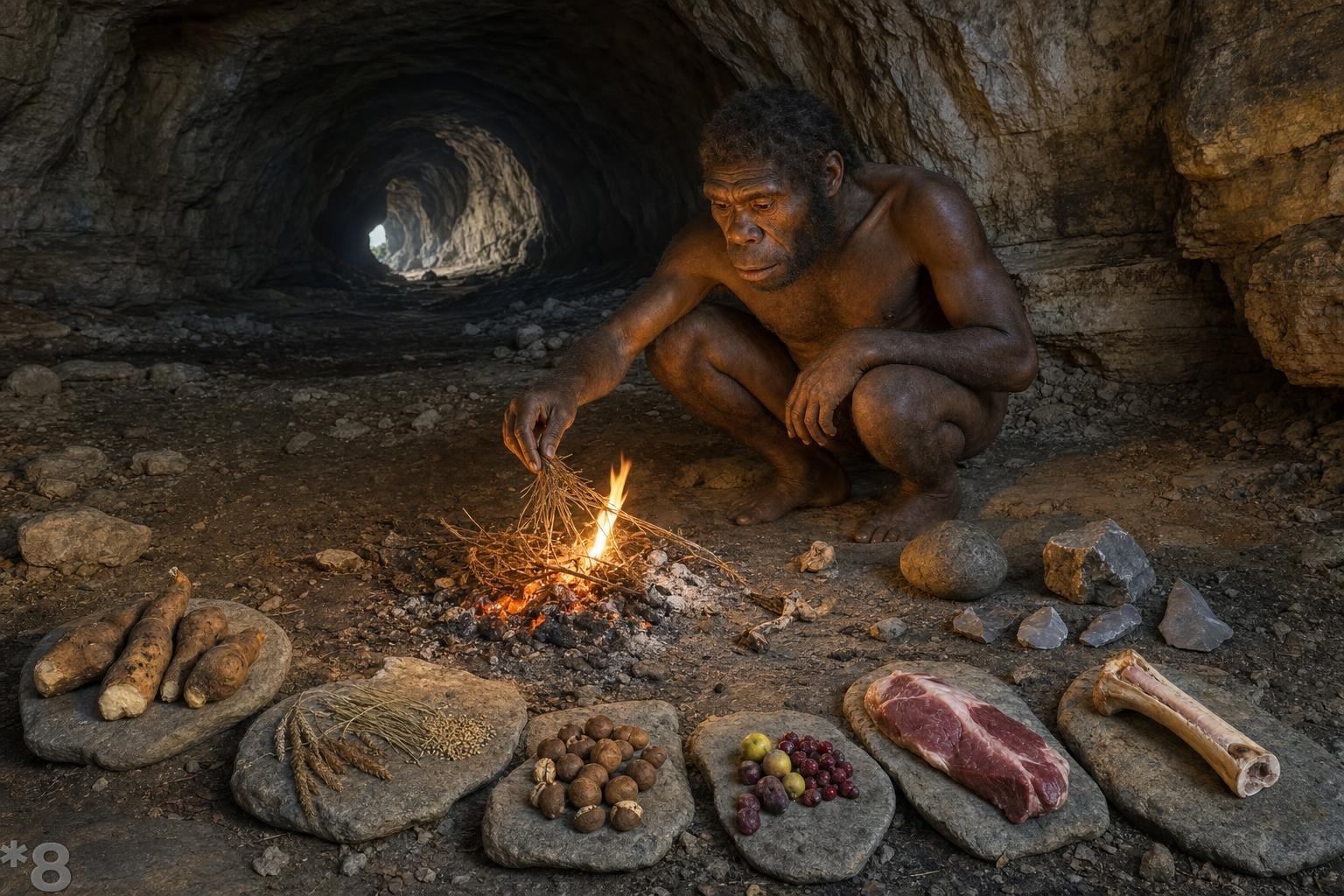
Older claims exist. At Koobi Fora in Kenya, burned sediment in deposits of about 1.5 million years ago has been argued to come from hominin fire use, and the debate over it is still open [2]. Part of the difficulty is that savanna landscapes burn without any help, and the first use of fire may well have involved natural fires that people visited, kept alive or carried, rather than fires they started [3]. A burned patch from that period can be read either way.
At Gesher Benot Ya’aqov in Israel, the evidence takes a step further. Burned seeds, wood and flint are concentrated in particular spots in layers nearly 790,000 years old, which the excavators read as fire controlled by the people who camped there [4]. Control is an interpretation of the pattern, not something seen directly, but it is the most likely reading of the concentrations.
Fish at the lakeshore: the oldest cooked food on record
The same site holds the oldest claim that a particular food was cooked. In the archaeological horizons of Gesher Benot Ya’aqov, more than 95 per cent of the fish remains are pharyngeal teeth, the throat teeth of large carp; the bones themselves are almost absent. The teeth cluster around burned flint, and analysis of their enamel shows they were heated, but below 500 °C. Irit Zohar and colleagues read this as fish cooked and eaten on site about 780,000 years ago [5].
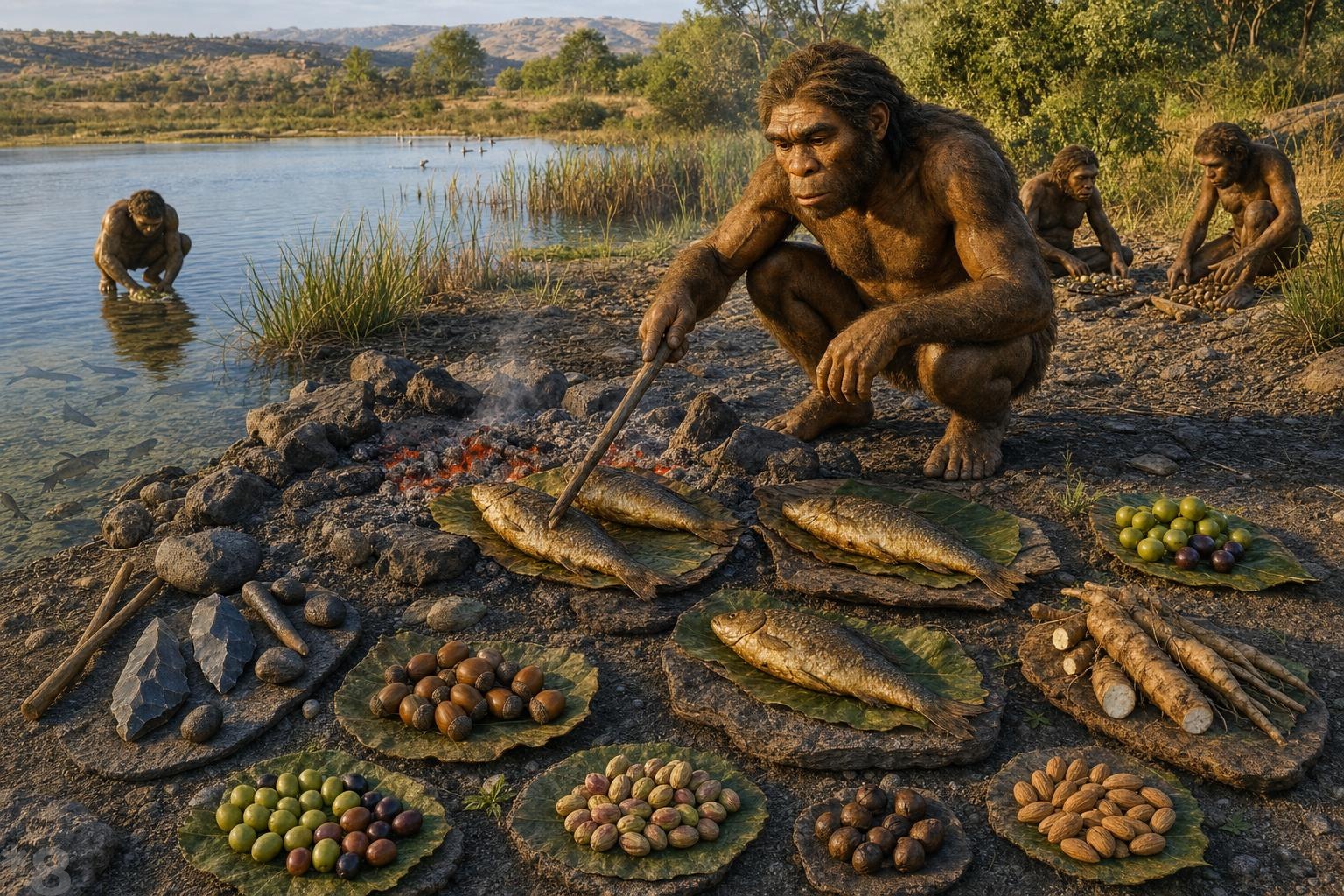
This is the earliest case in which the food itself carries the mark of heat, in a context tied to people. It is also a single site. Moderate heating is consistent with cooking but does not exclude other ways the teeth could have been heated near a fire, and no other site of that age has produced a comparable record. The claim is the most likely reading of good evidence, not yet a pattern.
From occasional fire to an everyday hearth
If fire was being controlled about 790,000 years ago in the Levant, it was not yet a constant part of life everywhere. Wil Roebroeks and Paola Villa surveyed the European record and found that habitual use of fire appears only from about 400,000–300,000 years ago; Europe’s earliest settlers seem to have managed without it [6]. In the Levant, the frequency of burnt flint through 16 metres of deposits at Tabun Cave shows fire becoming habitual between 350,000 and 320,000 years ago [7]. Other sites of that age fit the pattern. At Gruta da Aroeira in Portugal, about 400,000 years ago, burnt bone, charcoal and perhaps heated quartzite in a small area of the cave suggest fires made by people [8]. At Beeches Pit in Suffolk, dated by burnt flint to about 414,000 years ago, discrete burned patches are read as hearths that burned at 600–800 °C, with knapping debris that respects them [9].
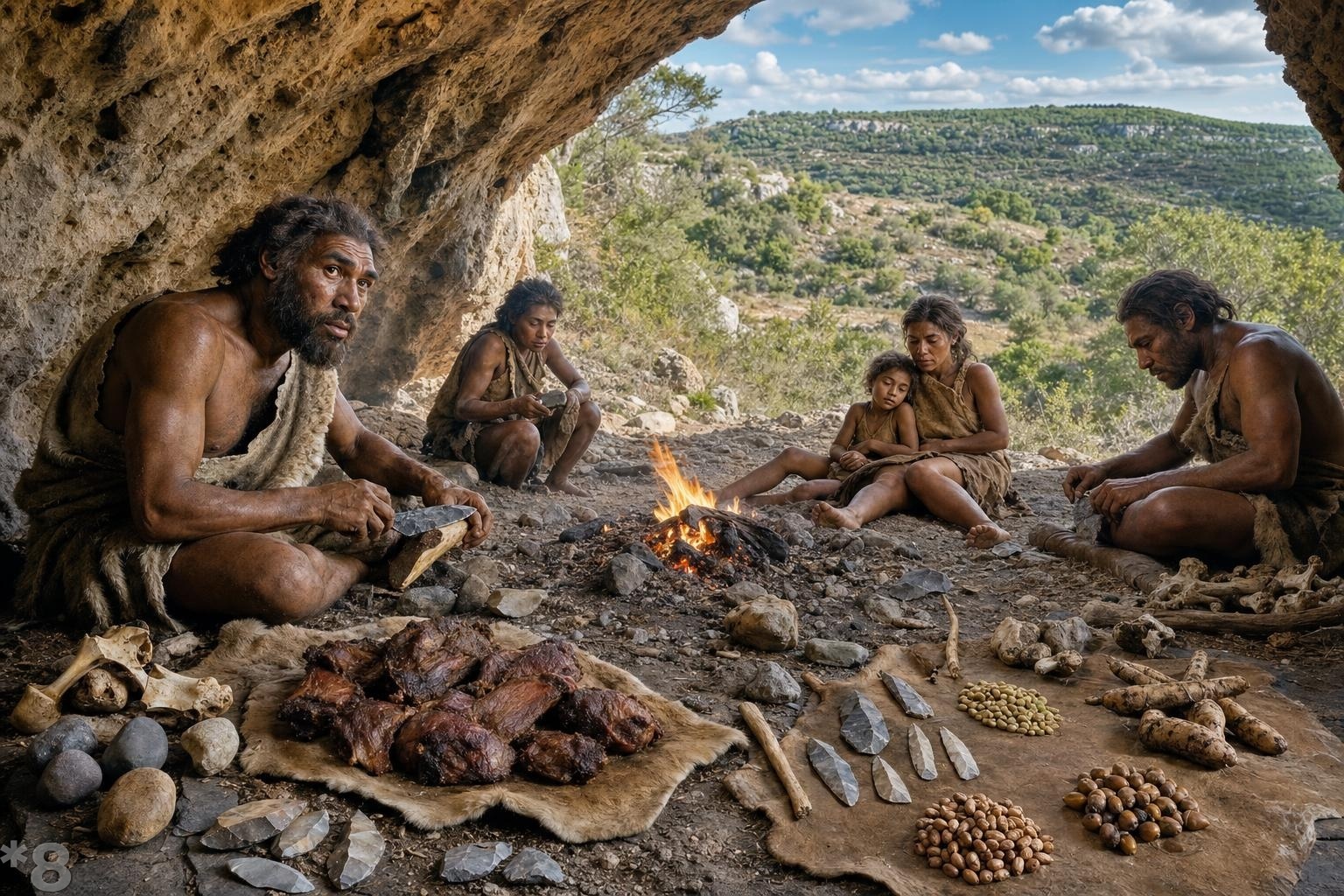
Making fire, rather than keeping one going, is a separate step. The oldest evidence for it comes from Barnham in England, about 400,000 years ago, a site with no atlas entry [10]. Once fire could be made at will and was used every day, cooking most food becomes a reasonable expectation. But that expectation is an inference from the fire record. It is not the same as finding the cooked food.
Cooked plants: late because they rarely survive
Plant foods are the hardest to see. Direct evidence for cooked plant food is far younger than the fire record: charred starchy rhizomes at Border Cave in South Africa, up to 170,000 years ago [11], and charred starchy tissue in hearths at Klasies River, about 120,000 and 65,000 years ago [12]. Neither site has an atlas entry. In the dental calculus of Neanderthals from Shanidar in Iraq and Spy in Belgium, Amanda Henry and colleagues found plant microfossils; at Shanidar, many of the grass-seed starches were damaged in a way consistent with cooking [13]. Shanidar also preserves charred lumps of plant food made with pounded pulses, though five of the six come from Upper Paleolithic layers rather than the Neanderthal deposits [14]. In northern Australia, people at Madjedbebe between 65,000 and 53,000 years ago left the charred remains of a range of plant foods, some of which needed processing before they could be eaten [15].
The late date of these finds is mainly a matter of survival. A charred root or seed lump is a rare accident of preservation, and the methods that identify it are recent. The finds set a latest possible date for cooking plants, not a first one.
The cooking hypothesis runs ahead of the evidence
A long-running argument starts from biology rather than archaeology. Richard Wrangham and colleagues proposed that the smaller teeth and larger female body size of early Homo erectus, about 1.9 million years ago, are signs of a diet already improved by cooking [16]. Rachel Carmody and Wrangham later set out how cooking raises the energy a body gets from the same food [17]. If they are right, cooking began almost a million years before the oldest secure fire.

The archaeological record has not reached that date. The gap may mean that cooking began later than the hypothesis needs, or that the earliest fires left little that survives; both readings remain in play [3]. One related idea has been tested and not supported: that larger brains were paid for with smaller guts. A comparison of 100 mammal species found no such trade-off [18]. That test weakens one route to the hypothesis but does not settle when cooking began.
Zhoukoudian shows how fire evidence can mislead
For much of the twentieth century, Zhoukoudian in northern China, the cave of “Peking Man”, was cited as the oldest controlled fire. Re-examination of Layer 10, the earliest archaeological horizon, found burned bones but no ash or charcoal, and so no direct evidence of burning in place there [19]. The famous “ash” accumulation in Layer 4 was interpreted as silts laid down by water [20]. Later work reported evidence of fire used and maintained in Layer 4 [21]. The site is a reminder that a burned bone, a dark layer and a hearth are different things, and that each claim has to be tested on its own.
Pots added a new way to cook, much later
Cooking equipment arrives at the end of this story. At Xianrendong Cave in China, the oldest pottery sherds come from contexts dated to 20,000–19,000 years ago, made by mobile foragers; the authors suggest the vessels may have served for cooking [22]. On Incipient Jōmon pots from Japan, about 15,000–11,800 cal BP, the charred residues analysed came in most cases from freshwater and marine organisms [23]: the first direct evidence of what early pots held over a fire.

Pottery made boiling and stewing easy, but it did not start cooking. By the time the first pots were made, people had been cooking for hundreds of thousands of years.
So when did humans start cooking?
The answer depends on which evidence is asked for. Burning in a place people used is attested about a million years ago [1]. The oldest food shown to have been cooked is fish, about 780,000 years ago, at one site [5]. Fire became an everyday part of life in Europe and the Levant from about 400,000–300,000 years ago [6, 7], and the oldest surviving cooked plant foods are about 170,000 years old [11]. The biological argument places the start near 1.9 million years ago [16], earlier than any of this evidence. What can be said with confidence is that cooking is older than our species, and that its beginning has not yet been found.
What remains uncertain
No find marks the first cooked meal, and none is likely to: the evidence sets latest possible dates, not first ones. The oldest claim of a cooked food rests on a single site, and the heating of the fish teeth is read as cooking rather than shown to be. Burned material older than about a million years remains open to natural explanations, and how often early hominins used natural fire rather than making their own is unknown. The long gap between the cooking hypothesis and the archaeological record has two possible explanations, and the record cannot yet choose between them. Cooked plant foods are underrepresented because they rarely survive, so their late appearance says little about when people began to cook them.
| Claim | What supports it | Label | Sources |
|---|---|---|---|
| Something burned in a place hominins used at Wonderwerk Cave about a million years ago. | Burned bone and ashed plant remains in thin sections, burned where they lie. Nothing shows what, if anything, was cooked. | Strong | 1 |
| Fire was controlled at Gesher Benot Ya’aqov nearly 790,000 years ago. | Burned seeds, wood and flint concentrated in particular spots; control is the excavators’ reading of the pattern. | Probable | 4 |
| Fish were cooked and eaten at Gesher Benot Ya’aqov about 780,000 years ago. | Carp pharyngeal teeth heated below 500 °C, clustered around burned flint, at a single site. | Probable | 5 |
| Habitual fire use began about 400,000–300,000 years ago in Europe and the Levant. | A survey of the European record; the frequency of burnt flint through the Tabun Cave sequence. | Moderate | 6, 7 |
| People could make fire at will about 400,000 years ago. | Evidence of fire-making at Barnham, England; one site. | Moderate | 10 |
| Starchy plant foods were cooked by about 170,000 years ago. | Charred rhizomes at Border Cave; charred starchy tissue in hearths at Klasies River. | Strong | 11, 12 |
| Cooking began about 1.9 million years ago with early Homo erectus. | Smaller teeth, larger female body size and the energetics of cooked food; no archaeological evidence of that age. | Interpretive | 16, 17 |
| Early pots were used to cook aquatic foods by about 15,000 cal BP. | Charred residues on Incipient Jōmon pottery, mostly from freshwater and marine organisms. | Strong | 23 |
Sources
- Berna, F., Goldberg, P., Horwitz, L. K., et al. (2012). “Microstratigraphic evidence of in situ fire in the Acheulean strata of Wonderwerk Cave, Northern Cape province, South Africa.” PNAS 109(20), E1215–E1220. DOI: https://doi.org/10.1073/pnas.1117620109
- Hlubik, S., Cutts, R., Braun, D. R., et al. (2019). “Hominin fire use in the Okote member at Koobi Fora, Kenya: new evidence for the old debate.” Journal of Human Evolution 133, 214–229. DOI: https://doi.org/10.1016/j.jhevol.2019.01.010
- Gowlett, J. A. J., & Wrangham, R. W. (2013). “Earliest fire in Africa: towards the convergence of archaeological evidence and the cooking hypothesis.” Azania 48, 5–30. DOI: https://doi.org/10.1080/0067270X.2012.756754
- Goren-Inbar, N., Alperson, N., Kislev, M. E., et al. (2004). “Evidence of hominin control of fire at Gesher Benot Ya‘aqov, Israel.” Science 304, 725–727. DOI: https://doi.org/10.1126/science.1095443
- Zohar, I., Alperson-Afil, N., Goren-Inbar, N., et al. (2022). “Evidence for the cooking of fish 780,000 years ago at Gesher Benot Ya’aqov, Israel.” Nature Ecology & Evolution 6, 2016–2028. DOI: https://doi.org/10.1038/s41559-022-01910-z
- Roebroeks, W., & Villa, P. (2011). “On the earliest evidence for habitual use of fire in Europe.” PNAS 108, 5209–5214. DOI: https://doi.org/10.1073/pnas.1018116108
- Shimelmitz, R., Kuhn, S. L., Jelinek, A. J., et al. (2014). “‘Fire at will’: the emergence of habitual fire use 350,000 years ago.” Journal of Human Evolution 77, 196–203. DOI: https://doi.org/10.1016/j.jhevol.2014.07.005
- Sanz, M., Daura, J., Cabanes, D., et al. (2020). “Early evidence of fire in south-western Europe: the Acheulean site of Gruta da Aroeira (Torres Novas, Portugal).” Scientific Reports 10, 12053. DOI: https://doi.org/10.1038/s41598-020-68839-w
- Preece, R. C., Gowlett, J. A. J., Parfitt, S. A., et al. (2006). “Humans in the Hoxnian: habitat, context and fire use at Beeches Pit, West Stow, Suffolk, UK.” Journal of Quaternary Science 21, 485–496. DOI: https://doi.org/10.1002/jqs.1043
- Davis, R., Hatch, M., Hoare, S., et al. (2026; published online December 2025). “Earliest evidence of making fire.” Nature 649, 631–637. DOI: https://doi.org/10.1038/s41586-025-09855-6
- Wadley, L., Backwell, L., d’Errico, F., et al. (2020). “Cooked starchy rhizomes in Africa 170 thousand years ago.” Science 367, 87–91. DOI: https://doi.org/10.1126/science.aaz5926
- Larbey, C., Mentzer, S. M., Ligouis, B., et al. (2019). “Cooked starchy food in hearths ca. 120 kya and 65 kya (MIS 5e and MIS 4) from Klasies River Cave, South Africa.” Journal of Human Evolution 131, 210–227. DOI: https://doi.org/10.1016/j.jhevol.2019.03.015
- Henry, A. G., Brooks, A. S., & Piperno, D. R. (2011). “Microfossils in calculus demonstrate consumption of plants and cooked foods in Neanderthal diets (Shanidar III, Iraq; Spy I and II, Belgium).” PNAS 108, 486–491. DOI: https://doi.org/10.1073/pnas.1016868108
- Kabukcu, C., Hunt, C., Hill, E., et al. (2023). “Cooking in caves: Palaeolithic carbonised plant food remains from Franchthi and Shanidar.” Antiquity 97, 12–28. DOI: https://doi.org/10.15184/aqy.2022.143
- Florin, S. A., Fairbairn, A. S., Nango, M., et al. (2020). “The first Australian plant foods at Madjedbebe, 65,000–53,000 years ago.” Nature Communications 11, 924. DOI: https://doi.org/10.1038/s41467-020-14723-0
- Wrangham, R. W., Jones, J. H., Laden, G., et al. (1999). “The raw and the stolen: cooking and the ecology of human origins.” Current Anthropology 40, 567–594. DOI: https://doi.org/10.1086/300083
- Carmody, R. N., & Wrangham, R. W. (2009). “The energetic significance of cooking.” Journal of Human Evolution 57, 379–391. DOI: https://doi.org/10.1016/j.jhevol.2009.02.011
- Navarrete, A., van Schaik, C. P., & Isler, K. (2011). “Energetics and the evolution of human brain size.” Nature 480, 91–93. DOI: https://doi.org/10.1038/nature10629
- Weiner, S., Xu, Q., Goldberg, P., et al. (1998). “Evidence for the use of fire at Zhoukoudian, China.” Science 281, 251–253. DOI: https://doi.org/10.1126/science.281.5374.251
- Goldberg, P., Weiner, S., Bar-Yosef, O., et al. (2001). “Site formation processes at Zhoukoudian, China.” Journal of Human Evolution 41, 483–530. DOI: https://doi.org/10.1006/jhev.2001.0498
- Gao, X., Zhang, S., Zhang, Y., & Chen, F. (2017). “Evidence of hominin use and maintenance of fire at Zhoukoudian.” Current Anthropology 58(S16), S267–S277. DOI: https://doi.org/10.1086/692501
- Wu, X., Zhang, C., Goldberg, P., et al. (2012). “Early pottery at 20,000 years ago in Xianrendong Cave, China.” Science 336, 1696–1700. DOI: https://doi.org/10.1126/science.1218643
- Craig, O. E., Saul, H., Lucquin, A., et al. (2013). “Earliest evidence for the use of pottery.” Nature 496, 351–354. DOI: https://doi.org/10.1038/nature12109
In the atlas
Spot something wrong in this article?